One Leg. One Finish Line. One Lesson I Will Never Forget.

Tony's Book on Amazon.com.
Born without hands or feet, Tony proved you can do much more than you initially believed.
By Coach Larry Weber
Two moments changed everything I thought I knew about human potential.
The first happened to me personally. I ran the Original Ultimate Runner Competition — a single-day gauntlet of five events: a 10K, 400 meters, 100 meters, a mile, and a full marathon. Before that day, I believed what most people believe: that the body has firm limits, that the mind hits a wall, that enough is enough. What I discovered instead was that the ceiling we accept is almost always lower than the ceiling that actually exists. Running four events before a marathon didn't break me. It expanded me. It rewired what I thought was possible — for myself and, ultimately, for every athlete I would ever coach.
The second moment didn't happen to me at all. I was just lucky enough to witness it.
Atlanta, 1996
I was standing at the edge of the track at the Atlanta Paralympic Games, waiting for my athlete, Tony Volpentest, to run his 200-meter heat. Tony was the fastest Paralympic sprinter in the world — the reigning world record holder in the 100 and 200 meters, a two-time gold medalist, the kind of competitor whose focus before a race was almost sacred. My dear friend and Tony's coach at the time, Bryan Hoddle, stood beside me. We were locked in — watching, waiting, preparing.
Then something happened in the heat just before Tony's.
A young man came out of the blocks like a thunderclap — powerful, explosive, instantly in the lead. He turned the curve with everything he had. And then, without warning, his prosthetic leg fell off and fell to the track.
He went down. His race was over. Years — maybe a lifetime — of preparation, sacrifice, and dreaming had come down to this single moment, and it was gone in a second.
I braced myself for what I assumed would come next: the long, devastating walk off the track that athletes endure when everything collapses at once. The quiet that descends. The dignity of defeat was accepted.
That is not what happened.
What He Did Next
The young man hopped on one leg back to the spot where his prosthetic had fallen. He reached down, picked it up off the track, and tucked it under his arm. And then — somehow, impossibly — he turned toward the finish line.
And he hopped.
One leg. Prosthetic under his arm. Two hundred meters of track between him and a finish line that meant nothing now in terms of the competition — and everything in terms of who he was.
The crowd understood before the announcement. Thousands of people rose to their feet. The cheers that filled that stadium was not the roar of victory. It was something rarer and more powerful — the sound of human beings recognizing the human spirit in its purest form.
He crossed the finish line physically and emotionally spent, the way a person looks when they have given literally everything they have. There was not a dry eye in the Atlanta Olympic Stadium.
I have coached athletes for decades. I have stood at finish lines at state championships, national competitions, and world events. I have never seen anything like what I saw that day. And I pray I never forget it, because it is the clearest picture I have ever witnessed of what it means to refuse to quit.
What He Taught Me
When I am tired — and there are days in this coaching life when I am very tired — I think about that young man.
When a goal seems too far away, when a kid I believe in is struggling, when I am tempted to lower my expectations for someone because the road ahead looks too hard, I think about a prosthetic leg tucked under an arm and one foot pushing off the track, again and again, toward a finish line nobody was requiring him to reach.
He didn't have to finish. Nobody would have blamed him for stopping. The competition's rules didn't require it. Only something inside him did.
That something is what I look for in every athlete I coach.
It cannot be measured in a time trial or any other practice. It doesn't show up on a fitness assessment. But I have learned — through the Original Ultimate Runner, through Tony Volpentest's gold medal runs, through decades of watching young people like the young man hopping on one leg, discover what they are made of — that this quality exists in far more people than we expect. It is buried under fear, under past failure, under the weight of other people's low opinions.
Our job, as coaches, teachers, and parents, is to believe in it before they do.
The Coaching Conviction I Cannot Let Go.
The Church has stated that sports can reveal the best aspects of the human spirit, suggesting that the highest athletic achievements point to something greater than themselves. I have seen this to be true. I have stood in stadiums and felt it profoundly. What that young man accomplished in Atlanta was not just a demonstration of athleticism; it was a testimony. It was a living declaration that the human spirit, created in the image of God, is resilient and not easily broken.
Tony Volpentest went on to win gold that same day. Bryan and I cheered until we had nothing left. Ross Perot stood with us. It was amazing.
But the moment I have carried with me for thirty years is not the gold medal. It is a young man with one leg and a prosthetic under his arm, hopping toward a finish line that only mattered because he decided it did.
I tell every athlete I coach the same thing:
"You can always do more than you initially believed."
Always.
Leave nothing at the finish line of your most important goals. Believe in the gifts God placed inside you — because He placed them there for a reason, and He does not make mistakes. And when the race falls apart in ways you never planned for, when everything you prepared for is suddenly gone — pick up what's left, tuck it under your arm, and keep moving.
The finish line is still there.
Blessings,
Coach Weber Philippians 4:13
Watch Tony Volpentest's gold medal run and world record at the 1996 Atlanta Paralympic Games: Tony Volpentest — CBS Atlanta Paralympics Coverage (YouTube)
You can also read about the Original Ultimate Runner Competition for more information about this event.
Note: When Bryan moved on to lead the USA Track and Field Paralympic program, I had the privilege of taking the baton as Tony's coach. What followed were some fond memories of my coaching life — world championships in the 100 and 200 meters, and a world record in the 200 meters on the track in Barcelona, Spain.
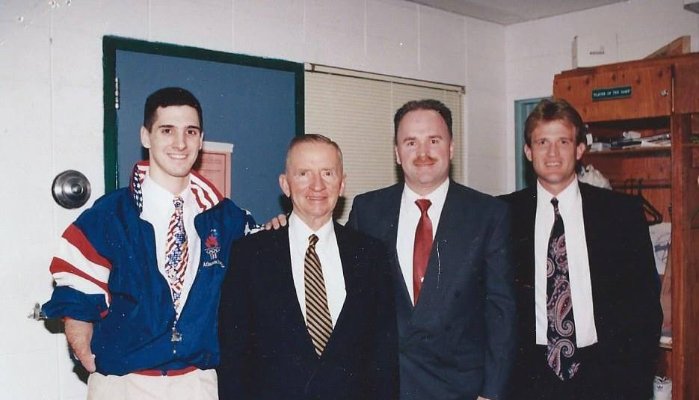
Left to Right: Tony Volpentest, Ross Perot, Bryan Hoddle, and Larry Weber