Why Every Great Accomplishment Begins with a Choice to Believe
Image Credit: Towiqu Barbhuiya
Believe. Believe. Believe.
During his years at the University of Kansas, a young distance runner earned All-America honors in cross country — and was told by a photographer to step out of the team picture because of the color of his skin. He had grown up in poverty on the Pine Ridge Indian Reservation in South Dakota, orphaned by twelve, worn down by years of rejection and racism. Back in his hotel room, he stood on a chair at the open fourth-floor window. He has said of that moment that he didn't want to die; he just wanted to go where it was quiet.
Then he heard a voice that sounded like his late father's: "Don't."
He stepped down, picked up a pencil, and opened the journal he carried with him. What he wrote was not a wish. It was a decision:
"Gold Medal. 10,000 meter run. God has given me the ability. The rest is up to me. Believe. Believe. Believe."¹
Almost no one had heard of Billy Mills when he lined up in Tokyo on October 14, 1964. He had never won an individual national title. The New York Times sized him up as a thousand-to-one dark horse.
In the run-up to the Games, not a single reporter had asked him a question. On the final lap, world-record holder Ron Clarke shoved him into the next lane, and Tunisia's Mohammed Gammoudi burst between them both into the lead. Mills looked finished.
Then, over the last 100 meters, he swung out to lane four and found a gear no one knew he had — sprinting past both men to win gold in one of the greatest upsets in Olympic history. His time was almost fifty seconds faster than he had ever run in his life. Moments after he crossed the line, an official ran up to the new champion with a question no one had thought to ask before the race: "Who are you?" More than sixty years later, the world knows exactly who he is — the only American ever to win the Olympic men's 10,000 meters.²
His victory did not begin on that last lap. It began at that window, with a choice to believe.
Belief Is an Act of the Will
Belief is not a feeling that washes over you. It is a choice you make — often before there is any evidence to support it.
That is why belief must come first. Before the training plan, before the business plan, before the first mile, the first chapter, the first day of anything worth doing, there is a decision: I believe this is possible, and I believe God gave me what I need to pursue it.
Your talents and abilities were given to you for a reason. You should feel at home with them because of who gave them to you. If you don't believe in your unique gifts, who will?
An athlete I coached used to say, "You have to believe it to achieve it." The phrase oversimplifies things — we'll get to that — but it points at something true. How can you accomplish a goal you don't believe is possible? You can't. Nobody trains wholeheartedly for a race they've already decided they'll lose.
What Belief Is Not
Here I need to be honest with you, because a great deal of nonsense gets preached on this subject.
Belief is not a magic formula. It is not a claim check you present to the universe. Some voices in our culture — and, sadly, some in the church — teach that if you believe hard enough, name it boldly enough, everything you want will come to pass.
Life does not work that way. I have coached for more than four decades, and I can tell you plainly: not every dream sincerely believed comes true. Athletes get injured. Businesses fail. Prayers are answered with "no" or "not yet." Even Billy Mills, on the final lap of the Olympic final itself, felt his blood sugar crashing — numbness, blurred vision — from the hypoglycemia he battled throughout his career. Belief did not exempt him from hardship. It carried him through it.
So let me put the two truths side by side, because both are true:
Belief does not guarantee that what you want will happen. But every great accomplishment, when it happens, still starts with belief.
There is no contradiction there. Belief is not a guarantee — it is a prerequisite. Remove it, and the accomplishment never has a chance. That is why choosing to believe is the wise choice. You are not purchasing an outcome. You are opening the door to one.
Belief + Hard Work + Smart Work = Breakthrough
Simply believing in yourself won't be enough. Belief that never laces up its shoes is just daydreaming. As Billy Mills wrote in that journal: God has given me the ability — the rest is up to me.
The rest is the work. The early mornings. The unglamorous middle miles of any worthwhile project, when the excitement of starting has faded and the finish line is nowhere in sight. And the best strategies in the world to get the job done.
And here is what forty years of coaching has taught me about that middle stretch: belief leaks. It is not a tank you fill once. Zig Ziglar said it best:
"People often say that motivation doesn't last. Well, neither does bathing — that's why we recommend it daily."³
That is why belief has to be instilled in others time and time again. When I tell an athlete "I believe in you," I don't say it once at the start of the season and consider the job done. I say it in October when the rain is sideways. I say it after the bad race, not just the good one. Belief must be renewed daily — in yourself and in the people you lead. A coach, a parent, a teacher, a friend who understands this becomes a wellspring others draw from when their own belief runs dry.
As you do the work, something happens: your internal belief meter rises. Small breakthroughs feed bigger ones. You begin to trust the gifts God placed in you — not because everything went smoothly (it won't), but because you've watched yourself get up one more time than you fell.
The Gift Comes with a Purpose
Steve Prefontaine put it in words every runner knows: "To give anything less than your best is to sacrifice the gift."⁴
Your talent is a gift from God. It was not given to you by a coach, a friend, or anyone else — and it was not given to you for you alone.
Recognizing your gifts with humility and gratitude frees you to use them in service and love of others. When you push past a perceived limitation, you hand everyone watching permission to attempt the same. Billy Mills' gold medal launched a generation of runners who suddenly saw that boundaries were negotiable. Your breakthrough — at whatever level, in whatever arena — does the same for your team, your family, your community.
That is the whole point. It was never just about you.
If I could teach only one thing in life, it would be this: believe in and reach your God-given potential, so that you can help others do the same.
Wrapping It Up
Belief will not hand you everything you want. It was never designed to. But no great accomplishment in the history of the world ever started without it.
So make the wise choice. Believe in the gifts God has given you — He knew what He was doing when He gave them. Do the work those gifts deserve with the best strategies possible. Renew that belief daily, in yourself and in the people around you. And when things get hard — they will — don't give up, don't slow down, and don't lose hope until you cross the finish line of your journey.
A young man once climbed down from a window ledge at the lowest moment of his life and wrote a promise in his journal. A year and a world away, that promise carried him to the top of the Olympic podium.
Believe. Believe. Believe.
Watch the race. No written account does justice to those final 100 meters. See Billy Mills' gold medal run for yourself, in the official Olympic footage from Tokyo, October 14, 1964:
Blessings,
Coach Weber
Philippians 4:13
Endnotes
1. Billy Mills has recounted the hotel window incident and journal entry publicly many times, including in interviews with WBUR's Only A Game ("'I Healed A Broken Soul': Billy Mills' Unexpected 1964 Olympic Win," May 22, 2020), the On Being project ("Olympians Are Chosen by the Gods," 2019), and WMUK public radio (Gordon Evans, September 17, 2015). Details vary somewhat across Mills' own tellings — accounts place the incident in different years of his University of Kansas career (roughly 1959-1961) and in different cities, so no specific date or location is claimed here. The elements constant across his tellings are: the All-America photograph snub, the fourth-floor hotel window, standing on a chair, hearing his late father's voice say "Don't," and immediately writing the goal in his journal. The journal wording used here follows the WMUK interview ("Gold Medal 10,000 meter run, God has given me the ability, the rest is up to me, believe, believe, believe"). In some tellings, including On Being, Mills — who is Oglala Lakota — renders the line "The Creator has given me the ability." Both versions come from Mills himself.
2. Race facts: The men's 10,000 meters at the Tokyo Olympic Games was held October 14, 1964. Mills' winning time of 28:24.4 was an Olympic record and a personal best by nearly fifty seconds — the first time he had ever broken 29 minutes. (The world record, 28:15.6, belonged to Ron Clarke of Australia, who took bronze; Mohammed Gammoudi of Tunisia took silver in 28:24.8.) The final-lap sequence — Clarke's push sending Mills into the next lane, Gammoudi surging between them, and Mills' closing sprint from lane four — is documented in the official race accounts and in World Athletics' feature "Billy Mills: Reflecting on his epic victory at the 1964 Olympic Games" (July 22, 2020), which also records Mills' account of experiencing low blood sugar, numbness, and blurred vision during the final lap. Mills was diagnosed with hypoglycemia after joining the Marine Corps in 1963. Per the U.S. Marine Corps History Division, Mills remains the only American ever to win Olympic gold in the event. The New York Times' "thousand-to-one dark horse" characterization is cited in World Athletics' heritage feature on Mills (January 2025). That no reporter had asked Mills a question before the race is documented by the International Olympic Committee's official athlete profile of Mills at Olympics.com ("Mills was so unheralded that, in the run-up to the Games, not one reporter had asked him a single question") and independently by the University of Kansas Memorial Unions biography, which records that in his two weeks in Japan before the race, no reporter sought an interview. The post-race "Who are you?" question is from Mills' own account, as quoted by the U.S. Olympic & Paralympic Museum ("An official comes up to me and says, 'Who are you, who are you?'"); the moment is corroborated in the University of Kansas account of a Japanese race official approaching Mills to ask his name.
3. Widely attributed to Zig Ziglar (1926-2012) across his recorded talks and writings. The line appears consistently in this form in published collections of his work, though no single original text or speech has been definitively identified as its first occurrence.
4. Widely attributed to Steve Prefontaine (1951-1975). The quotation circulates in this standard form and is closely associated with Prefontaine's legacy, though it comes to us through secondhand accounts rather than a documented primary source.
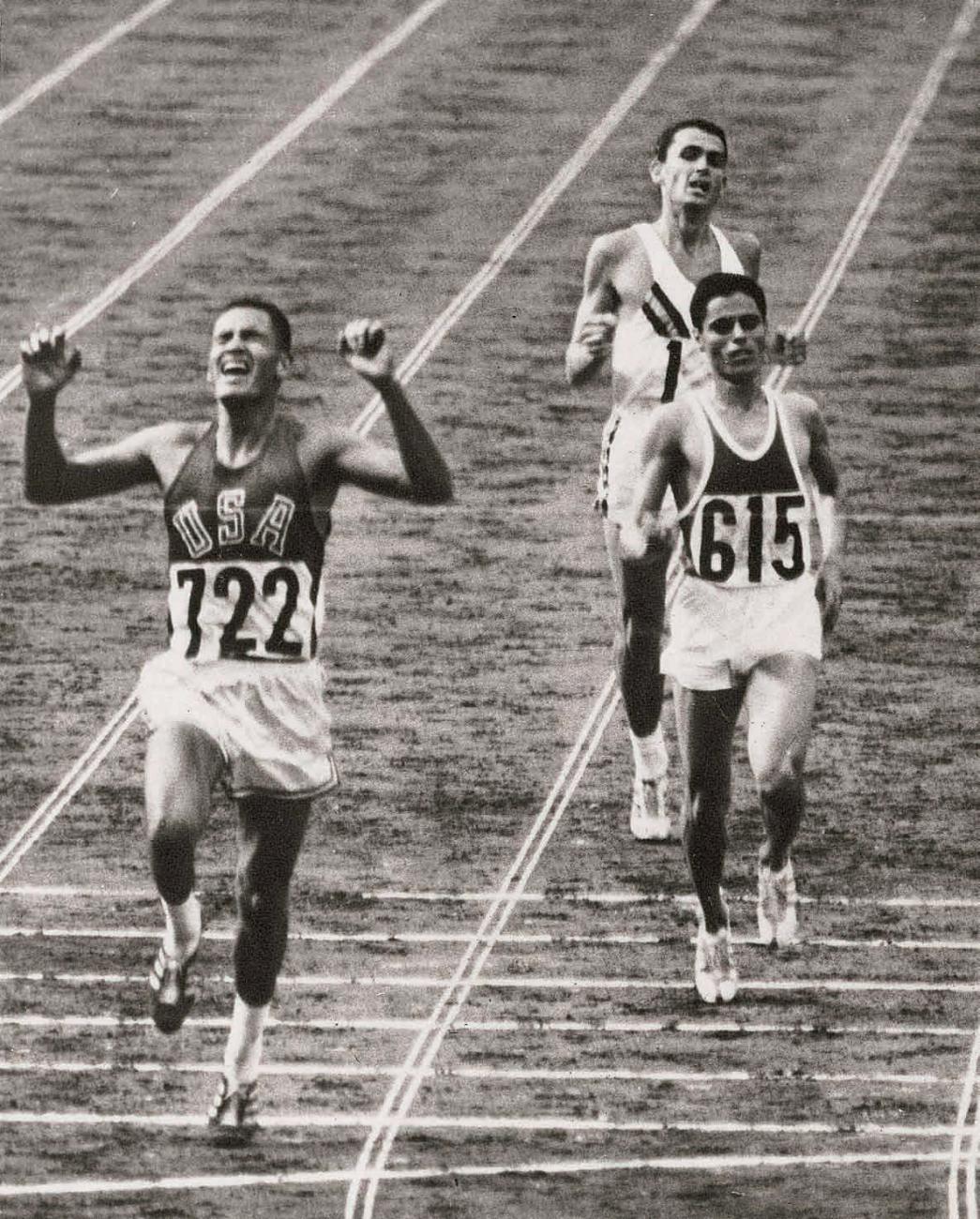
Billy Mills is the only American to win the 10,000 Meters in the Olympic Games. In 1964, Mills pulled off one of the great upsets in Olympic History. Believe, believe, believe.
By breaking his barriers, Billy Mills has helped thousands of others break their barriers through his speeches, movies, motivational talks, and more for decades, all based on his true life story.
Photo Credit: The Associated Press