The Toughest One-Day Race Ever: 5 Races, 33 Miles, One Impossible Day
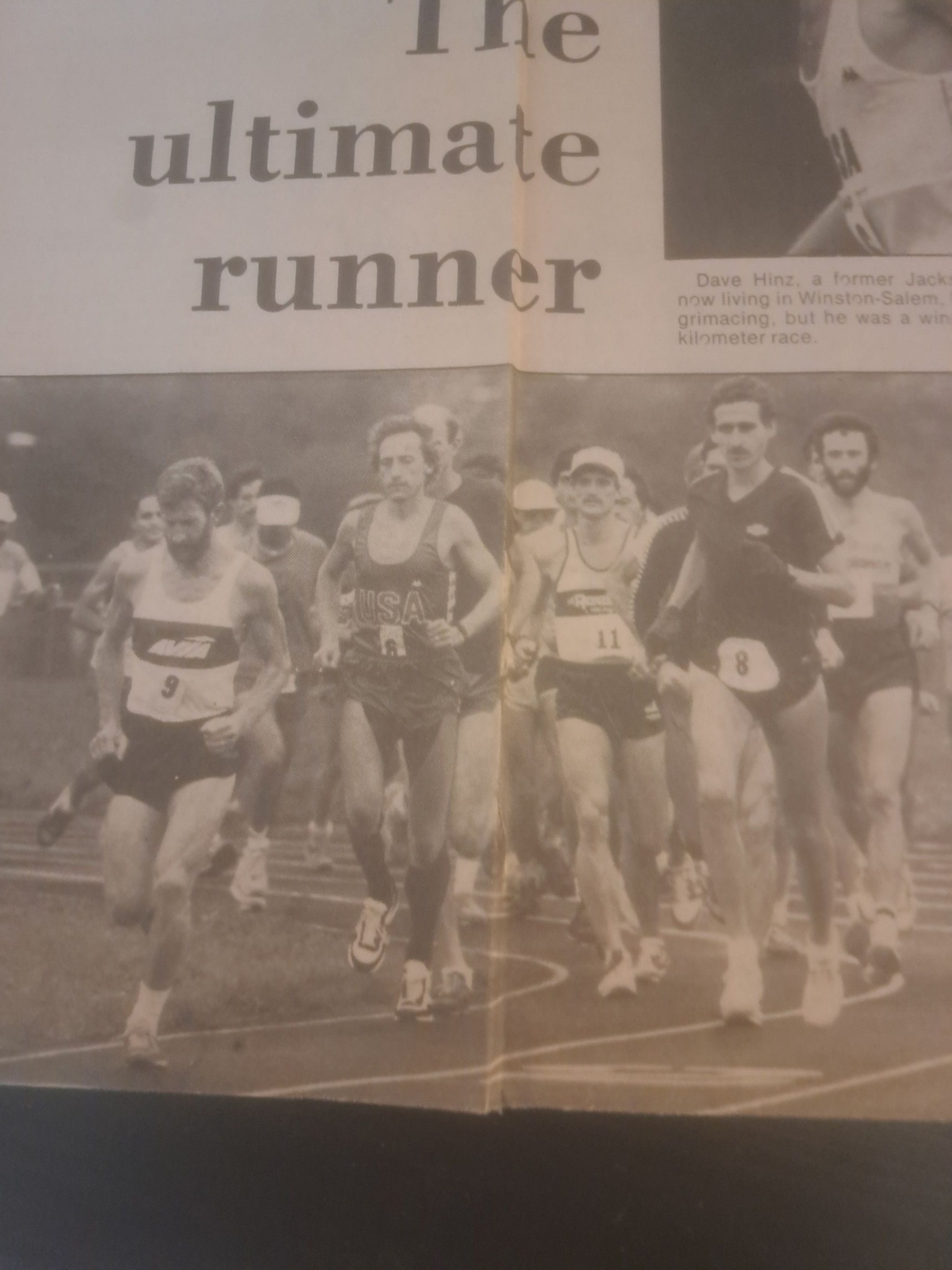
Race number 11—roughly where officials expected me to finish. To my left: 2:12 marathoner Dave Hinz, wearing a USA jersey. In the field: American 50-mile record holder Barney Klecker, Ultra Running Hall of Famers Charlie Trayer and Stefan Feckner, and Olympic 1500-meter qualifier John Craig. In later years, Marathon Olympians Don Kardong and Jeff Galloway ran the event.
The Race That Broke the Limits: Inside the Most Punishing One-Day Running Event Ever Conceived
Five races. Thirty-three miles. One impossible question: Who is the best all-around runner in the world?
I wrote about the Original Ultimate Runner Competition years ago, but I've never told the full story—the physiological details, the deeper motivations, the moments I've carried with me for nearly four decades. This is that story.
Five races. Thirty-three miles. One impossible day.
When the race officials called my name to come to the awards platform, my legs wouldn't respond.
Not fatigued. Not cramping. Non-functional.
They had to physically lift me—like moving a piece of furniture—and place me on the stage. I'd just been crowned "The Ultimate Runner" and best all-around runner in the world, but I couldn't support my own body weight.
That was October 1985. I was 27 years old. And I'd just set a record that was never broken — a cumulative point total across five races in one day that no one, not even the Olympic marathoners and Hall of Fame ultrarunners who competed in various years, would ever surpass.
I wrote about this race years ago. Told the story of the training, the strategy, the five impossible races. But I left out the most important part.
I never told you WHO I was running for in my original article that day.
Or what I discovered when my strength completely failed, and I had to be carried.
Now, 40 years later—after a rewarding journey that includes leading 15 state team cross-country and track and field championships as a head coach, being honored with induction into the Washington State Coaches Cross Country Hall of Fame, and having the privilege of coaching age group world record holders and Olympic Trials qualifiers—I’ve come to a deeper understanding of what transpired that day.
This is the complete story.
The Impossible Question
In the early 1980's, the running community had been debating a question for decades: Who deserves the title of best all-around runner in the world?
Is it the miler, combining speed and strength in perfect balance? The marathoner, testing the limits of human endurance? The sprinter, with their explosive power? The ultrarunner, pushing beyond what most consider possible?
Everyone had an opinion. Everyone claimed their specialty represented the pinnacle.
The Original Ultimate Runner Competition would settle it.
The format was diabolical in its simplicity: Run five races in one day—a 10K, 400 meters, 100 meters, a mile, and a marathon. Your score is cumulative based on placement in each event. Lowest total score wins.
No room for specialization. No hiding weaknesses. The champion would have to sprint like a 400-meter specialist, endure like a marathoner, and push VO₂ max like a miler—all within hours of each other.
Runner's World magazine writer Jim Harmon, who covered the race one year, called it "the last word in endurance running."
Looking at the carnage it left in its wake—Olympians who said once was enough, elite runners who couldn't stand afterward, world-class athletes comparing it to combat—he wasn't exaggerating.
The Field
The competitors who gathered in Jackson, Michigan, that day represented the elite of distance running:
Barney Klecker—American record holder at 50 miles, a mark that would stand for nearly 40 years.
Charlie Trayer—the world's third-ranked ultramarathon runner, later named Ultra Runner of the Year and inducted into the Ultrarunning Hall of Fame, and later called the grandfather of American ultrarunning.
Stefan Feckner—1988 Ultra Runner of the Year, another Hall of Fame inductee.
John Craig—thirteen-time Canadian national team member, six-time national 1500-meter champion, and 1980 Olympic qualifier.
Dave Hinz—a 2:12 marathoner who'd competed in the 1984 Olympic Marathon Trials and was a member of the lead pack with four-time Boston Marathon winner Bill Rogers, Olympian Tony Sandoval, and other major marathon winners.
These weren't weekend warriors. These were athletes who'd proven themselves on the world's biggest stages.
Over the years, the event would attract other legendary names. Olympic marathoner Don Kardong would compete once, finishing fifth, and later said, "I thought the roadkill looked better than I felt."
Jeff Galloway, another Olympian and renowned running author, would attempt it one year, comparing it to his Vietnam experience.
Both would walk away saying they'd never do it again.
But on this particular day in 1985, I wasn't on anyone's radar to win. A nationally ranked miler in my late twenties, I was looking for one last challenge before retirement.
My race number was 11—roughly where officials expected me to finish.
Nobody expected what would happen next.
My Theory: Milers Were the Answer
I'd spent months thinking about this question: Who really is the most versatile runner?
And I kept coming back to the same conclusion: it had to be a miler.
Think about it. Milers need both strength and speed. You can't run a competitive mile without raw speed—the kind sprinters possess. But you also can't sustain mile pace for four laps without endurance—the kind distance runners build.
The mile sits at the perfect intersection. Fast enough to require explosive power. Long enough to demand aerobic capacity.
I'd competed at the USA Track and Field Championships in the 1500 meters against Olympians like Steve Scott and Steve Lacy, and 3:52 miler Craig Masback. I knew what elite middle-distance running required.
A pure sprinter couldn't handle a mile. A pure marathoner couldn't keep up with the speed.
But a miler? A miler could do both.
And if the best all-around runner was going to be a miler, then maybe—just maybe—I had a shot.
Training on a Blank Piece of Paper
The problem was simple: I had no idea how to train for this.
There was no blueprint. No established program. No coach I could call who'd prepared athletes for five races in one day.
So I sat down at my kitchen table with a blank piece of paper and started figuring it out myself.
I didn't have credentials—no coaching certification or degree in exercise science. But I'd trained under excellent coaches and competed at the highest levels. And I'd learned something important: results matter more than credentials. What works, works.
I started sketching out ideas. Long runs to build aerobic base. Speed work to develop fast-twitch capacity. Tempo runs at lactate threshold to improve efficiency.
And then something clicked: lactate threshold training.
Most runners trained either slowly (easy distance) or fast (intervals). But there was a middle zone—roughly half-marathon pace—where the body learned to process lactate more efficiently. Training at that pace built endurance without destroying speed. I did not discover threshold running until the very end of my career while training for the Ultimate Runner. Threshold training was just becoming a training method in the early 1980's.
I wondered if I could make lactate threshold work as the foundation of my training. Long tempo runs at approximately half-marathon pace, combined with sprint work for the 400 and 100 meters, as well as 20 mile distance runs for the marathon.
It was unconventional. Unproven. Possibly stupid.
But it made sense.
So I started training. Alone.
The workouts were brutal. But slowly—week by week, month by month—adaptations happened.
In May, I ran 3:52.1 at the Main Street Mile in Olympia on a certified but loss-of-elevation course. Proof the training wasn't destroying my speed.
In February of that year, I had run 29:34 at the KOY Classic 10K in Phoenix. Evidence I could handle distance while maintaining speed. I finished about 20 seconds behind Boston Marathon champion Bill Rogers. I was excited that I was close enough to see him finishing.
The training was working.
But the real test was still ahead.
The Five Races: A Physiological Breakdown
To understand why the Ultimate Runner was uniquely brutal, you have to understand what the human body goes through when forced to race—not jog, but race—across every distance from 100 meters to 26.2 miles in a single day.
Race 1: The 10K
I ran conservatively, finishing fourth. My aerobic system was fully engaged, glycogen stores beginning to deplete.
Recovery: One hour.
Race 2: The 400 Meters
The 400 meters is an anaerobic nightmare. Blood lactate levels spike to 12-15 mmol/L. Heart rate hits 100% of maximum. The ATP-PC system gets hammered.
Now imagine running it after a 10K.
I lined up next to John Craig, the Olympic 1500-meter qualifier. Two middle-distance specialists are going head-to-head.
I edged him, John, at the line—first place.
Recovery: One Hour
Race 3: The 100 Meters (The Wet Sweats Incident)
I discovered my sweats were soaking wet. The drawstring was stuck. Officials were calling runners to the line.
I made a decision I can still barely believe: I ran in the wet sweats.
The fabric clung to my legs, restricting my stride. But I didn't panic.
Somehow—impossibly—I finished second.
Recovery: One Hour
Race 4: The Mile
My body was operating at VO₂ max—maximum heart rate and lung capacity; oxygen uptake plateaued, but demand stayed impossibly high.
John Craig made his move with 600 meters to go. I stayed on his shoulder.
With about 60 meters remaining, I made a crucial decision: I eased up.
Not because I couldn't match his kick. But because there was still a marathon to run.
Craig won the mile. I finished second.
I had chosen to save something for the marathon.
Recovery: Two hour break.
Race 5: The Marathon (The Great Unknown)
I had never run a marathon before in my life.
Here's what made this physiologically impossible:
A typical marathoner stores approximately 2,000 calories of glycogen. I'd already burned 775-925 calories in four previous races.
I was starting the marathon with roughly 60% of normal glycogen stores—equivalent to starting at mile 10-12 of a normal marathon.
The lead pack went out at a sub-2:20 pace. I let them go.
Mile 18. Mile 20. Mile 22.
I saw Dave Hinz, the 2:12 marathoner, slowing ahead, walking. The cumulative toll had caught him.
As I passed, I called out: "You've got this, Dave."
I did it not out of obligation, but because we were all enduring the same struggles together.
Mile 26.
I crossed the finish line.
And my legs gave out completely.
Why This Was the Toughest One-Day Event Ever
From a purely physiological standpoint, what we accomplished shouldn't have been possible.
The human body has three primary energy systems:
- ATP-PC System (powers 0-10 second efforts) - used in 100m
- Anaerobic Glycolytic System (powers 10 seconds to 2 minutes) - used heavily in 400m
- Aerobic System (powers efforts beyond 2 minutes) - used in mile, 10K, marathon
Most races test one, maybe two systems. The Ultimate Runner demanded maximum performance from all three—in succession—within a single day.
Unlike ultramarathons, Ultra races maintain steady, submaximal effort. The body never enters severe oxygen debt.
Unlike Ironman triathlons, Ironman events maintain sub-VO₂ max pacing throughout.
Unlike decathlons, the decathlon includes rest periods and doesn't require simultaneous maximum aerobic or anaerobic output.
The Ultimate Runner uniquely demanded:
- Maximum oxygen debt (400m producing 12-15 mmol/L lactate)
- Maximum aerobic power (miles at VO₂ max ceiling)
- Maximum aerobic endurance (marathon in glycogen-depleted state)
- All at racing intensity within 8-10 hours
No other event in history has compressed the entire spectrum of human running capacity into a single day.
When officials tallied the scores, they called my name. "The winner of the Ultimate Runner Competition is Larry Weber."
I had set a new event record—a cumulative point total that stood as the best in the competition's history.
What I've Never Told You Until Now
I've written about the Ultimate Runner before and shared the basics—the five races, the jelly legs, the victory.
I once mentioned in passing, in a different article about meaningful motivation, that I was running for someone else that day.
But I never included it in the Ultimate Runner story.
Until now, I've never publicly revealed my primary motivation for competing that day.
A young family member with cystic fibrosis came to watch me race.
At the time, the life expectancy for someone with cystic fibrosis hovered in the late teens or early twenties. She was approaching that age. She knew it. Her family knew it.
Despite everything she faced—the constant struggle to breathe, the medical treatments, the limitations—she was one of the most joyful people I'd ever met.
She was excited to watch me race. Proud of me.
And I felt an overwhelming responsibility not to let her down.
She struggled to breathe on an ordinary day. Just sitting still required effort.
And I had the privilege—the absolute, undeserved privilege—to run. To push my limits. To breathe freely, deeply, without thinking about it.
How dare I waste that gift?
On that day in Michigan, standing at the starting line of the marathon after four previous races, I realized something with crystal clarity:
I wasn't racing for myself anymore.
I was racing for her.
For someone who couldn't run herself but who found joy in watching someone else push the limits of what the human body could do.
Viktor Frankl, the Holocaust survivor, wrote: "He who has a why can bear almost any how."
My why was sitting in the crowd, smiling, believing in me.
When you're running for yourself, you can quit. Your brain gives you a thousand rational reasons to stop.
But when you're running for someone else—especially someone who can't run themselves—quitting becomes impossible.
Because it's not about you anymore.
When the miles got hard around mile 18, when my mind suggested I could slow down, I thought about her.
About her struggling to breathe while I breathed freely.
About her limitations, while I tested mine.
About her joy in watching me do what she couldn't.
And I kept running.
When the final miles should have broken me, when every muscle screamed for me to stop, when I had nothing left—I thought about her.
And I found something I didn't know existed: a reservoir of strength that doesn't come from training, talent, or willpower.
It comes from the love that God instills in us. The Breaking Point
After I crossed the finish line, after officials announced I'd won, after they had to lift me onto the awards platform because my legs wouldn't work—I found her.
She was smiling. That beautiful, radiant smile that lit up her whole face.
And she hugged me.
I can still feel that hug decades later.
The medal was just metal. The title was just words. The record was just numbers.
But that smile? That hug?
That was everything.
My legs had turned to jelly because I'd given everything—every ounce of physical, mental, emotional, and spiritual strength.
The tank was beyond empty.
And sitting in that chair, unable to stand, I had a realization that would change everything:
I didn't do this.
The training had been good. The strategy had been smart. But none of that explained what had just happened.
The math didn't add up. I was ranked around eleventh going into the event. My training shouldn't have been enough.
I wasn't strong enough for what I'd just accomplished.
Which meant something else had carried me. Someone else.
I thought about the prayer before the race. That simple, desperate plea: God, I need Your help. I can't do this on my own.
But sitting there with jelly legs, unable to stand, the evidence was undeniable:
I couldn't do it on my own.
My strength had failed. Completely. Absolutely.
And yet I'd finished and won.
Which meant the strength that carried me through wasn't just mine.
There's a verse I'd heard before. Philippians 4:13.
"I can do all things through him who strengthens me."
I'd always interpreted it as: God helps me be stronger.
But sitting in that chair, legs useless, unable to stand—I finally understood what it actually means.
It doesn't mean God makes you stronger.
It means God's strength works when yours runs out.
When my strength completely failed—when there was literally nothing left—His strength didn't fail. I truly leaned on my faith in those last miles.
Philippians 4:13 became my life verse from that day forward.
From that day on, I've signed everything: Blessings, Coach Weber, Philippians 4:13.
Not as a signature. As a testimony.
The Aftermath
John Craig said after the race, it was a great experience—but he would never do it again. Too physically demanding.
Dave Hinz agreed.
Don Kardong competed in a different year, finishing fifth: "I thought the roadkill looked better than I felt."
Jeff Galloway attempted it again the next year, comparing it to Vietnam.
These were world-class athletes, Olympians, saying the Ultimate Runner was one of the hardest things they'd ever done.
But none of them would surpass my all-time point total.
Why I'm Telling the Full Story Now
I kept parts of this story close for nearly four decades.
The young family member with cystic fibrosis passed away years ago. The disease eventually claimed her, as we all knew it would.
But the memory of that smile, that hug, that moment of pure joy—it's more meaningful to me than any medal or title I ever earned.
Because it taught me what my gift was actually for.
Not for my own glory. Not for my own satisfaction.
But for others. For the people who couldn't do what I could do.
Running became something different after that day. Something sacred. Something I couldn't take lightly because I knew it was a privilege not everyone had.
That's what transformed running from an activity into a calling. By offering this race up for something greater than self, my life changed in so many life-giving ways.
And that's why I coach the way I do—always looking for the kid who doesn't yet know what they're capable of, always believing in potential others can't see, always remembering that every gift we have is meant to be given in service of others.
I've had the privilege of coaching for 15 seasons and have been fortunate to see my teams win 15 Washington State Cross Country and track and field championships. I've had the opportunity to support talented athletes who set world records or who qualified for the Olympic Marathon Trials. Most importantly, I’ve enjoyed guiding countless teenagers as they discover strengths and abilities they didn’t realize they had.
In January 2026, I was inducted into the Washington State Coaches Cross Country Hall of Fame.
Every athlete I've ever coached has heard this story. Not to impress them with what I accomplished, but to teach them what I learned:
You will reach the end of your strength. That's guaranteed.
And that's exactly the point.
Because the breaking point—the moment when human strength ends—is where you meet God. Not in theory. But in desperate, absolute, undeniable dependence.
The Lesson
The Original Ultimate Runner Competition no longer exists. The event that once attracted Olympians and national champions faded into obscurity.
But the question it tried to answer still resonates:
What are human beings truly capable of when pushed to absolute limits?
The physiological data is clear: I accomplished something that shouldn't have been possible—racing at maximal intensity across every energy system in a single day.
The competitors' testimonies confirm it—Olympians across multiple years calling it the hardest thing they'd ever done.
And my own experience reveals a deeper truth: sometimes the breaking point isn't the end of the story. It's where the real story begins.
Because that's where you discover what you're made of when everything else is stripped away.
That's where you meet something—or Someone—carrying you when you can't carry yourself.
That's where jelly legs become testimony.
Nearly four decades later, the day I couldn't stand on my own remains the most important victory of my life.
Not because I won a race.
But because I learned what my gift was actually for.
My Ultimate Runner Competition record still stands as the best all-time point total in the event's history. The event is no longer held in its original form because it pushed the limits of human endurance in a single day. I'm sharing this more detailed version of the story now—including the physiological breakdown and the motivation I've mentioned only once before in a different context—because I believe the lessons I learned that day about purpose, sacrifice, and discovering strength beyond ourselves matter more than ever.
Blessings,
Coach Weber
Philippians 4:13
Note: I have a longer version of this story that is part of a future book.
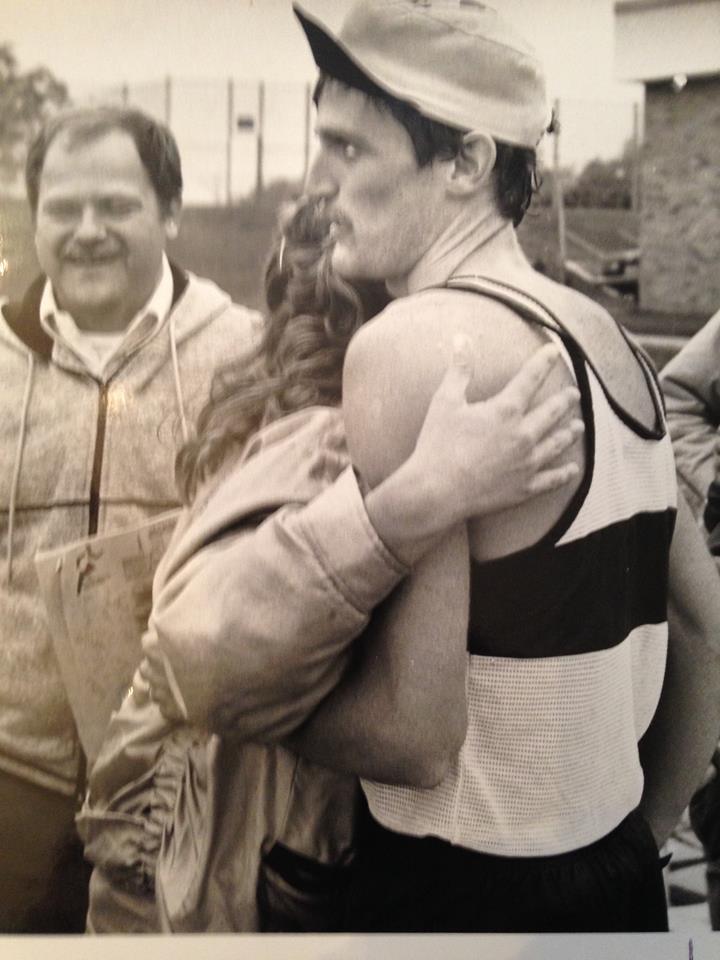
The hugs at the finish line before sitting down are what I remember.
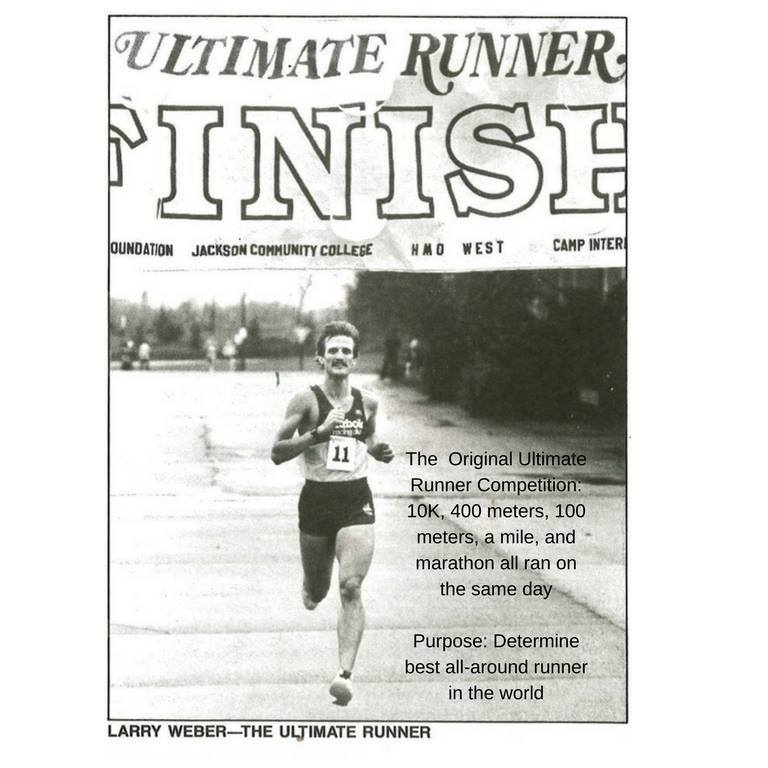
About Coach Weber
Coach Larry Weber is the author of Jesus on the Track: A Christian Athlete's Guide to Handling Hard Days, Building Mental Toughness, and Growing in Faith. A 2026 Washington State Cross Country Coaches Hall of Fame inductee, Weber has built 13 state championship programs, coached USA Olympic Marathon Trials qualifiers, and is the all-time record holder in the Original Ultimate Runner Competition (10 k, 400 meters, 100 meters, a mile and marathon all ran on the same day). He writes about faith, running, and formation at coachweber.org.
Jesus on the Track is available on Amazon.com: Amazon.com: JESUS ON THE TRACK: A Christian Athlete's Guide to Handling Hard Days, Building Mental Toughness, and Growing in Faith eBook : Weber, Larry: Kindle Store
My other book, Mile Three: How your teenagers toughest moments become their greatest strengths is scheduled for publication on Amazon.com May 2026.
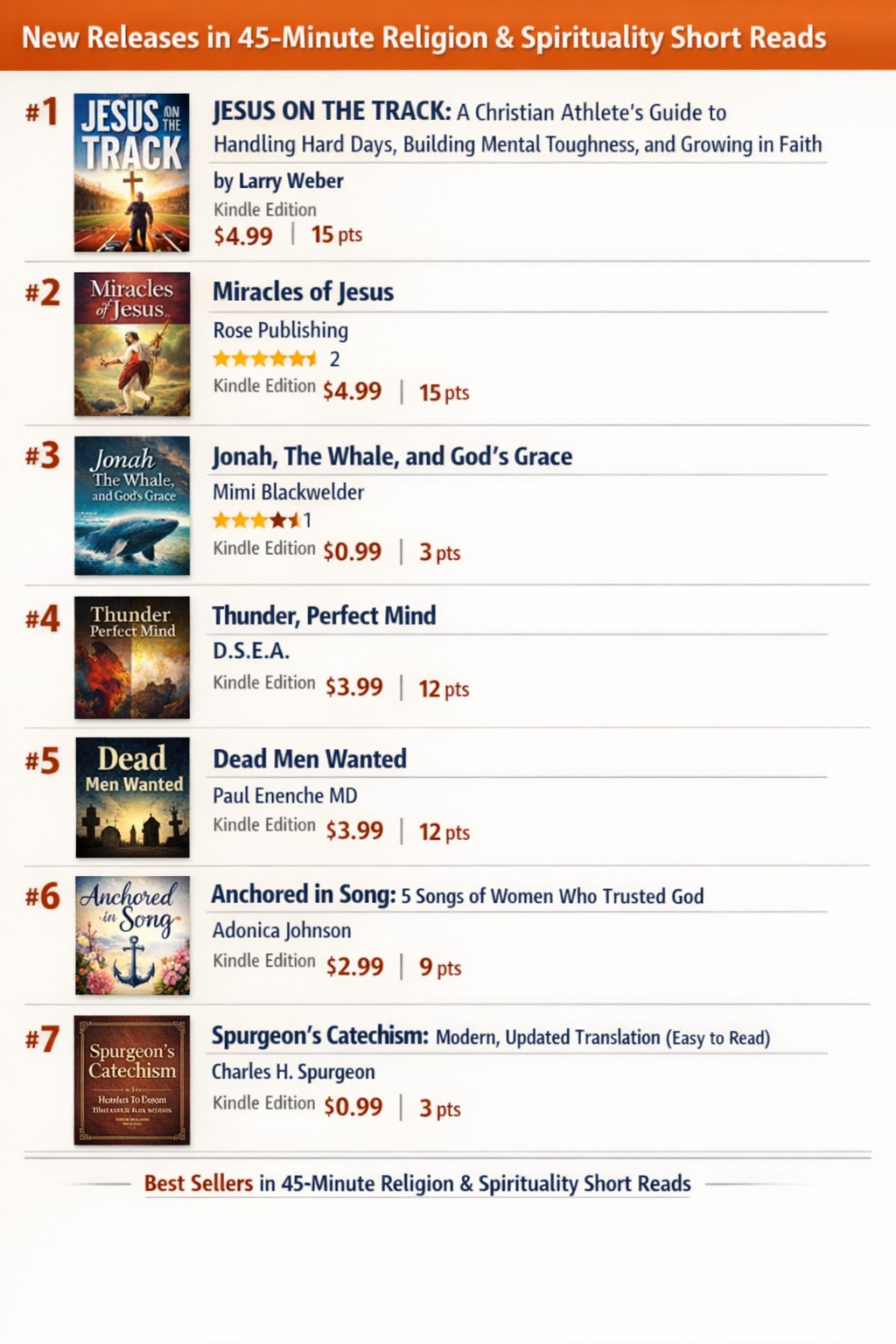
For those who have been asking, the paperback version of Jesus on the Track will be ready to print by Friday, April 24. I just finished incorporating some minor updates from the Kindle version. And for those who have heard about Mile Three — my longer book — it will be available on Kindle in about a week, with the paperback following a few weeks after that.
For those following along on the Amazon rankings — thank you for your encouragement. The #1 New Release is something I'm grateful for, though I want to be clear about what it means. Amazon ranks new releases separately from more established books with years of total sales behind them. It's a bit like being only at mile one of a marathon. Anything can happen over the next 25 miles. But mile one is behind us, and for that I'm thankful.
Please pass it along. All net proceeds go to support youth running.
If you like the book, please leave a short review on Amazon. This helps other athletes, parents, and coaches find the book online.
I can do all things through Christ who strengthens me. — Philippians 4:13
Coach Weber