Two Wings: What Faith and Science Both Reveal About Forming Young People.
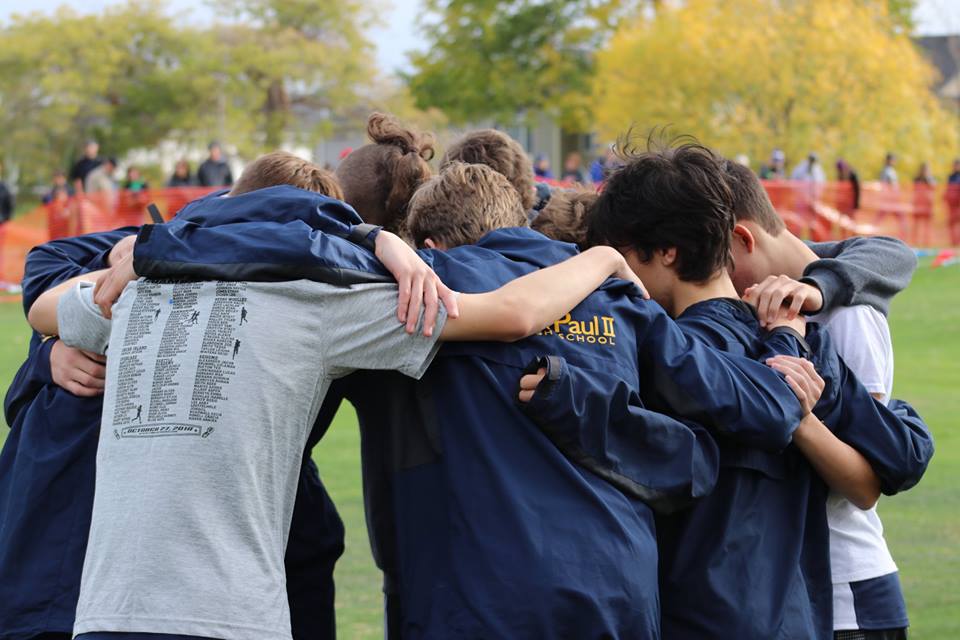
Faith becomes real when it is lived together. This is where character is formed — not alone, but shoulder to shoulder.
By Coach Larry Weber | coachweber.org
I have spent my whole life doing two things that most people think of as separate. I have coached young runners, and I have tried to form young Christians. On the track and on the course, I have watched sport build discipline, perseverance, and character. In the quieter places—after practice, before a race, during a hard season—I have watched Christian faith do something deeper still.
I have never held those two things in separate hands, and I have never seen them at war. Faith and reason belong together—the way they belong together in the Christian tradition. John Paul II describes this relationship at the opening of Fides et Ratio as a journey by which human beings engage truth more deeply. And the Church's teaching is equally direct: there can never be any real discrepancy between faith and reason, because the same God gives the light of reason and infuses faith.
Let me be clear about the foundation before I show you any evidence. Christian faith doesn't rest on science, and it never will. The point is not that arguments create that belief. The point is that Christian faith and honest investigation both serve the pursuit of truth.
Here is what faith and what character-building—supported by careful evidence—are both pointing toward.
Faith Builds the Very Self-Control That Running Builds
Running builds self-control in the body: attention, habit, restraint, and the ability to keep going when discomfort urges you to stop. In one of the more well-designed trials on exercise and the brain, the FITKids study found benefits for executive control and self-regulation in young people from sustained aerobic exercise.
What surprised me is how strongly research suggests that the Christian faith can strengthen self-control and self-regulation—not only as an abstract idea, but also in how a person actually manages behavior and endurance. A major review in Psychological Bulletin summarizes evidence that religion can promote self-control by shaping how people select and pursue goals, strengthening self-monitoring, and fostering self-regulatory strength.
And some experimental work even suggests a more immediate effect: when participants are subtly reminded of religious concepts before a difficult task, they show greater self-control and increased capacity to endure discomfort.
But Christian faith is not just a tool for better behavior. Christian faith is about trusting God and receiving God's life and love. When it does that, it reshapes the person from the inside out—including the kinds of self-control that coaches measure, and beyond what a measurement can fully capture.
Faith Formation in the Young Produces Measurable Character
Coaches want results, but good coaches also know great character is the ultimate outcome. It is formed over time through repeated choices—what to do, what to avoid, and how to respond when the body and the situation both resist.
Longitudinal research with large samples has found that religious upbringing—especially regular religious practice in adolescence—is associated with later outcomes across well-being, mental health, health-behavior, and character-strength measures. In an outcome-wide analysis, Chen and VanderWeele found associations with greater volunteering, a greater sense of mission, and more forgiveness of others, along with lower risk for depression, drug use, and risky behaviors.
A separate line of evidence suggests something else coaches recognize quickly: community matters. VanderWeele reviews longitudinal evidence that participation in religious community is associated with flourishing in multiple dimensions—meaning and purpose, health, character and virtue, and close relationships—and that the associations are stronger for communal religious participation than for private practice or self-identified spirituality alone.
Parents already sense this, even before they read a study. When a nationally representative survey conducted by Ipsos asked parents what they most want their children to care about, character traits led the list—honesty, responsibility, and respect.
And 94% of parents (secular and faith-based) agreed that children learn to be good people from the people around them. That "team effect" in formation is not merely sociological. In Christian terms, it matches how faith is lived: faith is a received life, practiced in worship, sustained in relationships, and expressed in habits of love.
It Works the Way a Team Works—Together
Character is not formed only by information. It is formed by belonging, correction, encouragement, and accountability—by being seen, challenged, and supported.
That is exactly why Christian formation in youth needs more than lessons. It needs a real Christian community and shared practices that place young people in an environment where faith and virtue are normal. Our program is built, on purpose, to be exactly that kind of community. We do not hope character happens by accident. We surround young people, every single day, with teammates and coaches who are reaching together for honesty, perseverance, forgiveness, and faith—because we believe, and the evidence agrees, that this is how a young person is actually formed.
Let me tell you about one young person, without telling you anything that could identify them, because their story is this whole article in a single life.
This runner came to our program having lost their faith somewhere after middle school. Not in anger—just in the quiet way it happens to so many young people, where faith slowly becomes an idea they used to hold, something abstract and far away, no longer real. I did not win them back with an argument. I am not sure anyone could have. What changed them was the team.
On our teams, faith is not a topic we talk about. It is something we do together every day. We pray as a team. We pray through struggles, out loud, when a season or a life is hard. We practice forgiveness when teammates fail each other, grace when someone falls short, and love that shows up in action rather than words. This young person did not hear about the Christian life. They were surrounded by it, daily, until it stopped being an idea and became something they could see and touch in the people around them. Faith became real again precisely because it was no longer esoteric. It was lived, right in front of them, by people who cared about them.
They regained their faith in that team. And they carry it to this day.
I have thought about that young person many times, because it names what was underneath everything: it was love. Not love talked about, but love in action—the kind that shows up, forgives, and keeps showing up. That is what made the faith real. The research calls it the strength of communal participation. My faith calls it charity, love lived out, and it is the very thing that gives all the other virtues their life. It is the reason I will never coach any other way.
In my coaching experience, the hardest moments often become the clearest teachers. When a season collapses, when training hurts, when expectations disappoint, the question is not simply "Can you endure?" Christian faith answers with "Who are you, and who is with you?"—and that changes what endurance means.
What Christian Faith Adds That Evidence Can Measure But Never Give
Science can describe patterns—how religious practices correlate with self-control, flourishing, and character outcomes. But Christian faith provides something deeper than the pattern.
The Christian faith provides a reason to persevere that is not dependent on results. It tells a young person that the "race" is not only about performance, but about endurance shaped by trust in God. Paul uses the language of competition directly when he writes about running and discipline: believers train toward an imperishable prize, and he disciplines his body and makes it his servant.
The New Testament insists on perseverance and formation imagery that long predates modern psychology: "Let us run with perseverance the race marked out for us," setting aside every weight that hinders.
And James explains why endurance has such power: the testing of faith produces perseverance, and perseverance completes its work toward maturity and wholeness—what we can call character development through endurance.
That "why" is not reducible to technique.
The Hardest Question—and the Honest Answer
Someone will object: "If you treat faith as useful for better behavior, isn't that just self-improvement wearing a cross?"
That warning is legitimate. Christian faith is not faith if it is merely instrumental—if God is used as a means for personal benefit only.
So here is the clarification: Christian faith is not believed first because it helps behavior; it helps behavior because it is true and lived. Faith and reason belong together as two correct and complete wings for arriving at truth.
And the Christian intellectual tradition has long held that faith rightly understood does not compete with honest inquiry. The history of science includes many devout Christians and clergy-scientists who integrated faith and research rather than treating them as enemies.
The Whole Person
Put it all together, and the conclusion is simple.
We are not raising runners. We are raising whole people—body and soul, discipline and meaning, character and the Christian God who gives character its depth.
Running builds the body and strengthens character. Christian faith forms the soul and gives character a reason strong enough to last. And the Christian faith carries a young person beyond the limits of coaching, because it is a matter of trusting in God and God's promise.
Two wings. That is what I'm trying to give these kids—because truth is not divided, and neither is Christian formation.
Run hard. Run smart. And don't be afraid to form the whole young person in Christian faith and Christian reason.
Blessings,
Coach Weber
Philippians 4:13 — "I can do all things through Christ who strengthens me."
About the Author
Coach Larry Weber is a 2026 Washington State Cross Country Coaches Hall of Fame inductee and the author of Mile Three: How the Hardest Part Builds the Best Kids and Jesus on the Track. He has coached USA Olympic Marathon Trials qualifiers, a Paralympic world record holder, and state championship high school teams across two schools. His article "Finding the Point of Diminishing Returns" is indexed in Google Scholar. He writes about faith, running, and formation at coachweber.org.
ENDNOTES
1. John Paul II. Fides et Ratio (Encyclical Letter on the Relationship Between Faith and Reason). Vatican City: Libreria Editrice Vaticana; September 14, 1998, opening line. It was the first papal encyclical devoted to faith and reason since Leo XIII's Aeterni Patris (1879). In its precise sense, the encyclical pairs faith with philosophical reason; this article applies the same "two wings" image more broadly to faith and the empirical sciences, consistent with the wider Christian tradition that holds that all truth has a single divine author.
2. This is the historic Christian position that truth cannot contradict truth. As the Catechism of the Catholic Church (§159) states, "there can never be any real discrepancy between faith and reason. Since the same God who reveals mysteries and infuses faith has bestowed the light of reason on the human mind, God cannot deny himself, nor can truth ever contradict truth." The formulation draws on the First Vatican Council's Dei Filius (1870).
3. This both/and conviction — that faith and reason each correct and complete the other — is the central argument of Fides et Ratio (1998); see also the broader Christian intellectual tradition running from the early Church through Augustine and Aquinas. The point in plain terms: reason cut off from faith tends toward meaninglessness, and faith cut off from reason tends toward mere sentiment; together they reach the fuller truth.
4. See Coach Larry Weber, "Character Is Built One Mile at a Time," coachweber.org, which reviews the evidence that sustained aerobic exercise strengthens executive control and self-regulation in young people — e.g., Hillman CH, et al. "Effects of the FITKids Randomized Controlled Trial on Executive Control and Brain Function." Pediatrics. 2014;134(4):e1063–e1071.
5. McCullough ME, Willoughby BLB. "Religion, Self-Regulation, and Self-Control: Associations, Explanations, and Implications." Psychological Bulletin. 2009;135(1):69–93. doi:10.1037/a0014213. A comprehensive review organizing the evidence around six propositions, including that religion can promote self-control, influence how goals are selected and pursued, facilitate self-monitoring, and foster self-regulatory strength, and that some of religion's associations with health and well-being may operate through these self-regulatory pathways.
6. Rounding K, Lee A, Jacobson JA, Ji LJ. "Religion Replenishes Self-Control." Psychological Science. 2012;23(6):635–642. Across four experiments, subtly priming religious concepts increased participants' self-control and their capacity to endure discomfort, providing experimental (causal) support for the association reviewed by McCullough and Willoughby (2009).
7. Chen Y, VanderWeele TJ. "Associations of Religious Upbringing With Subsequent Health and Well-Being From Adolescence to Young Adulthood: An Outcome-Wide Analysis." American Journal of Epidemiology. 2018;187(11):2355–2364. doi:10.1093/aje/kwy142. Longitudinal data from the Growing Up Today Study (sample sizes ranging from 5,681 to 7,458 depending on outcome; mean baseline age 14.74 years; 8–14 years of follow-up), analyzed with extensive control for confounding. Religious service attendance and prayer/meditation in adolescence were prospectively associated with a range of psychological well-being, mental health, health-behavior, and character-strength outcomes in young adulthood — including greater volunteering, a greater sense of mission, and more forgiveness of others, alongside lower risks of depression, drug use, and risky behaviors. As an observational study, it reports strong associations rather than causal evidence.
8. VanderWeele TJ. "Religious Communities and Human Flourishing." Current Directions in Psychological Science. 2017;26(5):476–481. doi:10.1177/0963721417721526. Reviews longitudinal evidence that participation in religious community is associated with numerous dimensions of flourishing — including happiness, meaning and purpose, mental and physical health, character and virtue, and close relationships — and notes that the associations are considerably stronger for communal religious participation than for private practice or self-identified spirituality alone.
9. 1 Corinthians 9:24–27. Paul draws directly on athletic training: runners compete for a perishable crown, believers for an imperishable one, and he writes that he disciplines his body and makes it his servant. Quotations and allusions to Scripture in this article are the author's own summaries; readers are encouraged to consult the full passages in their preferred translation.
10. Hebrews 12:1. "Let us run with perseverance the race marked out for us," setting aside every weight that hinders — an image of endurance and formation that long predates modern research on perseverance.
11. James 1:2–4. The testing of faith produces perseverance, and perseverance, allowed to complete its work, produces maturity and completeness — a first-century description of what contemporary psychology would call character development through endurance.
12. The history of science includes many devout Christians and clergy-scientists whose faith and research were deeply integrated — for example, Gregor Mendel, the Augustinian friar who founded modern genetics, and Georges Lemaître, the Catholic priest and physicist who first proposed what became known as the Big Bang theory. Their lives illustrate the article's thesis that, rightly understood, faith and empirical inquiry are not enemies but partners in the pursuit of truth.
13. Raising Good Kids: A National Study of Parents' Commitment and Struggles to Nurture Character. Commissioned by Character.org and conducted by Ipsos; nationally representative online survey of U.S. parents of children ages 6–18, conducted August 31 – September 16, 2022. Asked to name the core values they most want their children to hold, parents ranked honesty (62%), responsibility (59%), and respect (52%) at the top; 94% agreed that children learn how to be a good person from the people around them. The survey sampled parents generally, not any single faith group.

The trophy is the smallest thing in this picture. The character these young men built — and the coaches who walked with them — is what lasts.