Before the World Was Watching: Our Journey With World-Class Paralympic Athletes
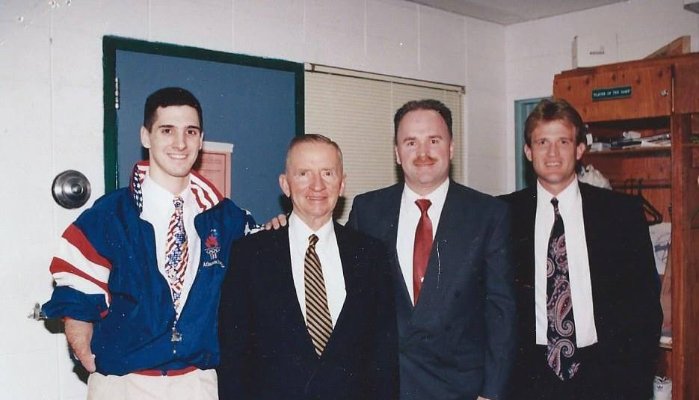
Left to right: Tony Volpentest, Ross Perot, Bryan Hoddle, Larry Weber
THE SIDE EFFECT
Sometimes the most important thing you do isn't the thing you set out to do.
Buckminster Fuller, one of the great minds of the twentieth century, built much of his life philosophy around a principle he called precession — the idea that a thing's true purpose unfolds sideways, as an unplanned effect of the goal it was actually chasing.¹
He illustrated it with a honeybee. The bee goes about its life with a single mission: gather nectar, make honey. It is relentlessly focused, biologically wired, and completely committed to that one purpose. And it succeeds. Day after day, season after season, the honey gets made.
But here is what the bee never knows.
While it moves from flower to flower, lost in its own small purpose, it carries pollen on its legs. Accidentally. Without intention or awareness. And that pollen cross-pollinates hundreds of crops — apples, almonds, blueberries, cucumbers — crops that feed billions of people across every continent on earth. Remove the honeybee from the equation, and the global food supply collapses.
The honey was never the point.
The bee's greatest contribution to the world happens in the margins of its mission, in the invisible work it does without ever knowing it's doing it. The side effect is the main event.
I've thought about that principle hundreds of times since the fall of 1995, when a phone call changed the direction of my life.
A PHONE CALL THAT CHANGED EVERYTHING
Bryan Hoddle has never been a man who wastes words. In fifty-plus years of knowing him, I've never heard him soften a truth to make it easier to swallow. What he told me that day was honest, clear, and without pretense — which is precisely why I listened.
He told me that a Texas billionaire, Ross Perot, had hired him to prepare a young man named Tony Volpentest for the 1996 Paralympic Games in Atlanta. Tony was already the defending Paralympic sprint champion, a double amputee born without hands or feet who ran on carbon-fiber prosthetics and balanced himself at the starting line on paint cans. Bryan was assembling a team, and he wanted to know if I was in.
I said yes before he finished the sentence.
What Bryan didn't tell me — what none of us could have known — was that we were stepping into something that would ripple outward for decades, touching veterans in rehabilitation hospitals, a family adopting a child, coaches rebuilding their entire life mission, and eventually the organizational structure of the United States Olympic Committee itself, adding the Paralympics.
We thought we were preparing a sprinter for a race.
We were actually participating in cross-pollinating new frontiers.
THE WEIGHT OF WHAT WE WERE CARRYING
The Paralympic Movement in 1995 occupied the outermost margins of American sports culture. There were no significant sponsorships, no major media contracts, no roadmap for what a professional disabled athlete even looked like. The word “Paralympic” drew blank stares at most dinner tables.
Bryan and I didn't have a blueprint. We built one.
I formed a company called Physically Able Sports — the first company in history dedicated solely to representing and promoting Paralympic athletes — and got to work on a strategic plan while Bryan threw himself into Tony's training. Albert Einstein once said that nothing happens until something moves. We moved fast, with the 1996 Games in Atlanta bearing down on us like a freight train.
Ross Perot was our anchor through all of it. The man who had twice run for President of the United States showed up to our partnership with his checkbook open and his ego nowhere to be found. He funded Tony's training. He mentored Bryan and me with the kind of clarity that only comes from someone who has built, lost, and rebuilt things on a grand scale. He cared deeply about two things: Tony Volpentest's success and the welfare of American veterans. In Ross Perot, those two passions would soon become one.
ATLANTA, 1996
I picked up Mr. Perot and his daughter from the airport myself.
The drive to Olympic Stadium buzzed with energy — Tony, Bryan's training plan, the Paralympic Movement, what all of this could mean. Mr. Perot was running for President, but he made something crystal clear before we ever reached the venue: this day was about Tony. At the press conference, with cameras rolling and reporters angling for political angles, he held the line.
Every question redirected back to the greatest Paralympian in the world — a young man from Washington State who had been born with no hands and no feet.
Ross Perot and I spoke together at the 1996 Paralympic Games press conference in Atlanta. He helped us achieve every strategic goal we set at the outset of our partnership in 1995. Working directly with him remains one of the highlights of my life.
That was the kind of man Ross Perot was.
When Tony crouched at the starting line of the 100 meters that afternoon, steadying himself against the paint cans he used for balance, the four of us — Bryan, Mr. Perot, his daughter, and I — sat together in the stands. What happened next is burned into me permanently.
Tony won the gold medal and broke the world record.²
The stadium erupted. Mr. Perot was out of his seat. You could see in his face, in that unguarded moment, exactly what this meant to him — not as a political calculation, not as a philanthropic investment, but as a man who had just watched someone he believed in become the best in the world.
We were all just a little excited.
WHAT HAPPENED NEXT NO ONE PLANNED
This is where the honeybee principle stops being a metaphor and starts being lived history.
In the days and weeks after Atlanta, Ross Perot began sending copies of the CBS tape — Tony crossing the finish line, the world record flashing on the scoreboard — to disabled veterans across the country. He paired the video with information about the prosthetic technology that Bryan and Tony had helped develop through months of biomechanical testing in Oklahoma City, where prosthetists had refined and improved their designs based on direct feedback from coaching a world-class sprinter.
Those improvements were shared freely. Just one man's belief that if something helped Tony Volpentest run faster, it might also help a twenty-two-year-old Marine walk again.
That is a side effect. That is the honeybee's pollen.
THE SOLDIERS' COACH
After Atlanta, Bryan Hoddle became head coach of the USA Paralympic Track and Field team, leading the team to Athens and performing brilliantly. But the moment that truly redirected his life came later, when he walked into a room full of veterans who had lost limbs defending their country.
Bryan Hoddle is not a man who cries easily.
He left that room to cry.
He came back changed. Not in the dramatic, overnight way stories sometimes romanticize — but in the slow, tectonic way that reshapes everything quietly and permanently. The veterans had done something in him. His life mission shifted on its axis that day, and it has never shifted back.
In time, the veteran community began calling him “The Soldiers' Coach” — a name that followed him for the rest of his career and, in the end, mattered to him more than any medal.³
None of that starts without Tony Volpentest running a world record in Atlanta.
None of that started without a phone call in 1995.
THE BABY NO ONE KNEW ABOUT
There is one more side effect I want to tell you about, because it's the kind of story that stops you cold.
When Ross Perot hired Bryan to coach Tony, Bryan was paid a salary. Bryan and his wife, Sherri, quietly used that money to adopt an infant son named Steven.
Mr. Perot didn't know this until Sherri mentioned it to his daughter, who told her father.
When he found out, Ross Perot — presidential candidate, Texas billionaire, one of the most powerful men in America — was thrilled.
A salary paid to prepare a sprinter had built a family. The honeybee had no idea what it was carrying.
TORONTO, AND THE MOMENT EVERYTHING SHIFTED
In 1997, my wife Julie and I helped secure Tony and his Australian rival, Neil Fuller, a spot in one of the most hyped sporting events of the year — the One-to-One Challenge at the SkyDome in Toronto, where Olympic champions Michael Johnson and Donovan Bailey would settle once and for all who was the fastest man on earth.⁴
Tony and Neil were the undercard. The sideshow. The warm-up act.
The crowd didn't get the memo.
When Tony barely outleaned Neil at the finish line, the SkyDome erupted. Not polite applause — a roar. A standing ovation that, by the end of the day, would be the loudest crowd response of the entire event, in a building that had come to watch two Olympic gold medalists race for a million dollars and the title of fastest human alive. Michael Johnson pulled a hamstring fifty meters in. The main event fizzled.
The undercard stole the show.
I've tried many times to describe what it felt like in that building during Tony and Neil's race. The hair standing up on your arms. The sense that something was shifting in the culture, that a wall was quietly coming down, and you were close enough to hear it falling. The mainstream sports world was waking up to what disabled athletes could do, what their stories meant, what the crowd was hungry for.
THE RIPPLES ARE STILL MOVING
The United States Olympic Committee is now the United States Olympic and Paralympic Committee. That name change didn't happen by accident, and it didn't happen in a vacuum. It happened because of a movement of many people, and that movement had names and faces and specific moments attached to it.
NBC broadcast roughly 1,200 hours of Paralympic coverage during the Tokyo Games in 2021.⁵ Paralympic medalists now receive financial recognition similar to that of their Olympic counterparts. These are not small things. These are cultural tectonic shifts.
I don't claim that Tony Volpentest caused all of this. History is always more complicated than any single story. But I was there in Atlanta. I was in Toronto. I watched the walls start to come down, one race at a time, one standing ovation at a time, one CBS tape mailed to a veterans' hospital at a time.
The side effects of that era are still moving through the world.
AFTER BRYAN — BARCELONA, AND A LESSON I DIDN'T KNOW I WAS LEARNING
Eventually, Bryan's path moved fully toward the veterans he had come to think of as his true calling, and I took over as Tony's head coach.
I coached Tony to two gold medals and a new world record in the 200 meters — 22.85 seconds — at the 1999 ISOD World Championships in Barcelona, Spain.⁶
It should have been the headline of this section. But looking back now, decades later, I think the medals were the honey. The side effect was something else entirely.
Coaching a world-class sprinter forced me to learn sprint mechanics at a depth I never would have reached otherwise — the drive phase, the turnover, the posture and arm carriage that separate a fast runner from an efficient one. I didn't know it at the time, but I was carrying pollen of my own.
I have spent most of my coaching life working with middle-distance and distance runners. And to this day, the sprint mechanics I learned preparing Tony for Barcelona still show up in how I coach a sixteen-year-old training for the 1600 meters.
Better posture through the last 200 meters of a race. A more powerful arm drive coming off the final turn. An economy of movement that saves a tenth of a second here, a tenth there — the kind of thing a distance coach with no sprint background simply doesn't see. I've even had the privilege of coaching a few outstanding sprinters over the years, and every time, my time coaching Tony is still in the room with me.
I didn't set out to become a better distance coach in Barcelona, Spain. I set out to help one athlete run one race well. The rest was the pollen on my legs.
Another side effect of the partnership. Maybe the quietest one of all — and maybe the one still paying dividends every single season.
THE PEOPLE WHO MADE THE FIRST CHOICE
If I'm being completely honest about where the real heroism lives in this story, it doesn't live with any of us on that team. We were the support crew.
It lives with Tony's parents.
They were handed a child born with no hands and no feet, and they made a choice — daily, quietly, without any guarantee of outcome — to raise him toward greatness. That is not a small thing. That is an act of faith so foundational that everything else in this story rests on top of it.
I remember introducing Tony at a government leadership event after the Games. He thanked his parents from the stage. The room, filled with seasoned, unsentimental professionals, went quiet in a specific way — the way rooms go quiet when something true is being said. Then they stood and applauded.
I saw that happen many times. Standing ovations before he said a word, just from watching the tape of Tony running in Atlanta. People were undone by a man who balanced himself on paint cans and ran faster than almost any human being alive.
God had a plan for Tony Volpentest. I believe that without reservation. But a plan requires people willing to say yes at every step along the way — his parents first, then Ross Perot, Bryan Hoddle, a prosthetist in Oklahoma City, and a race director in Toronto who answered her phone and understood the vision on the very first call.
Every one of them chose to carry the pollen forward.
ONE FINAL WORD
The honeybee never knows.
It doesn't know about the apple orchards, the almond groves, or the cucumber fields. It doesn't know about the billion people eating food that exists because of something it did without awareness or intention. It just moves from flower to flower, faithful to its design, and the world is fed.
When you step into your own calling — the thing you were made to do, the gift that is uniquely yours — the most important work you'll do might be the work you never see. The veteran who stands up straighter. The family that is built. The child who watches a man with no feet cross a finish line first and decides, for the first time, that their own life has no fixed ceiling. The distance runner, forty years later, who runs a smarter last 200 meters because his coach once learned sprint mechanics for an entirely different reason.
Those are the side effects.
And sometimes, if you're paying attention, you begin to realize that the side effects were the main event all along.
God works all things together for good.
— Coach Weber
Philippians 4:13
ENDNOTES
1. R. Buckminster Fuller's concept of “precession” — in which a bee's true purpose (pollination) unfolds as a side effect of the goal it is actually pursuing (nectar) — is documented in Fuller's Critical Path (St. Martin's Press, 1981). See also davidya.ca, “Making a Living through Precession (Bucky Fuller),” https://davidya.ca/2013/02/28/making-a-living-through-precession/.
2. Tony Volpentest set a 100-meter world record of 11.36 seconds at the 1996 Atlanta Paralympic Games, defending gold medals won at the 1992 Barcelona Games. “Atlanta 1996 Paralympic Games American Gold Medalists,” U.S. Olympic & Paralympic Museum, https://usopm.org/atlanta-1996-paralympic-games-american-gold-medalists/; Wikipedia, “Tony Volpentest,” https://en.wikipedia.org/wiki/Tony_Volpentest.
3. Bryan Hoddle's extensive work with wounded veterans, including at Walter Reed Army Medical Center and the Lakeshore Foundation, and his role as USA Paralympics Track and Field Program Director beginning in 2002, is documented independently by the Invictus Foundation. Invictus Foundation, “About,” https://invictusfoundation.org/about/.
4. The Bailey–Johnson 150-meter match race took place at Toronto's SkyDome on June 1, 1997. Wikipedia, “Bailey–Johnson 150-metre race,” https://en.wikipedia.org/wiki/Bailey%E2%80%93Johnson_150-metre_race; CBC Sports, “Meet me in the middle: The weird Donovan Bailey vs. Michael Johnson 150m race,” August 10, 2017, https://www.cbc.ca/sportslongform/entry/bailey-johnson-150-match-race. Tony Volpentest's own site independently lists the event among his career highlights: “About Tony,” TonyVolpentest.com, https://www.tonyvolpentest.com/about-tony.html.
5. NBCUniversal presented a record 1,200 hours of Paralympic Games programming for the Tokyo Paralympics. NBCUniversal, “Tokyo Paralympics Feature Record Programming Across NBCUniversal,” press release, August 17, 2021, https://www.nbcuniversal.com/press-release/tokyo-paralympics-feature-record-programming-across-nbcuniversal-beginning-opening.
6. Tony Volpentest set a 200-meter world record of 22.85 seconds at the 1999 ISOD World Championships in Barcelona, Spain. Tony Volpentest, “About Tony,” TonyVolpentest.com, https://www.tonyvolpentest.com/about-tony.html.
We secured all rights to the CBS Video mentioned in 1997 and used clips in other Paralympic Promotions throughout the United States during our tenure with Paralympic Sports. You can watch the video below.
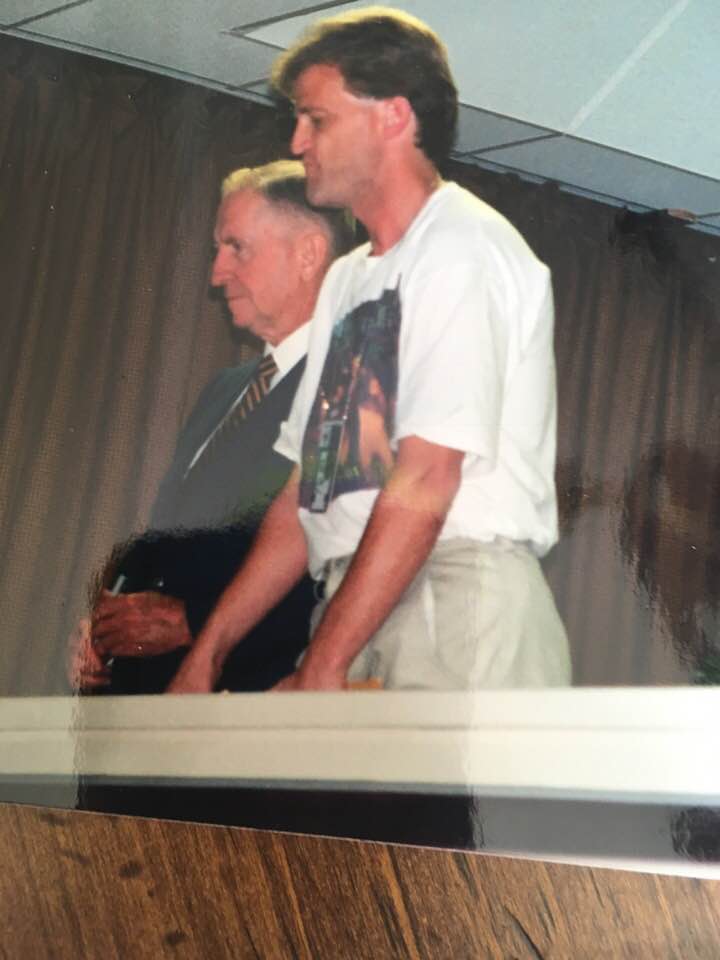
Ross Perot and Larry Weber speaking at a press conference in Atlanta