He Ran Like It Was Personal
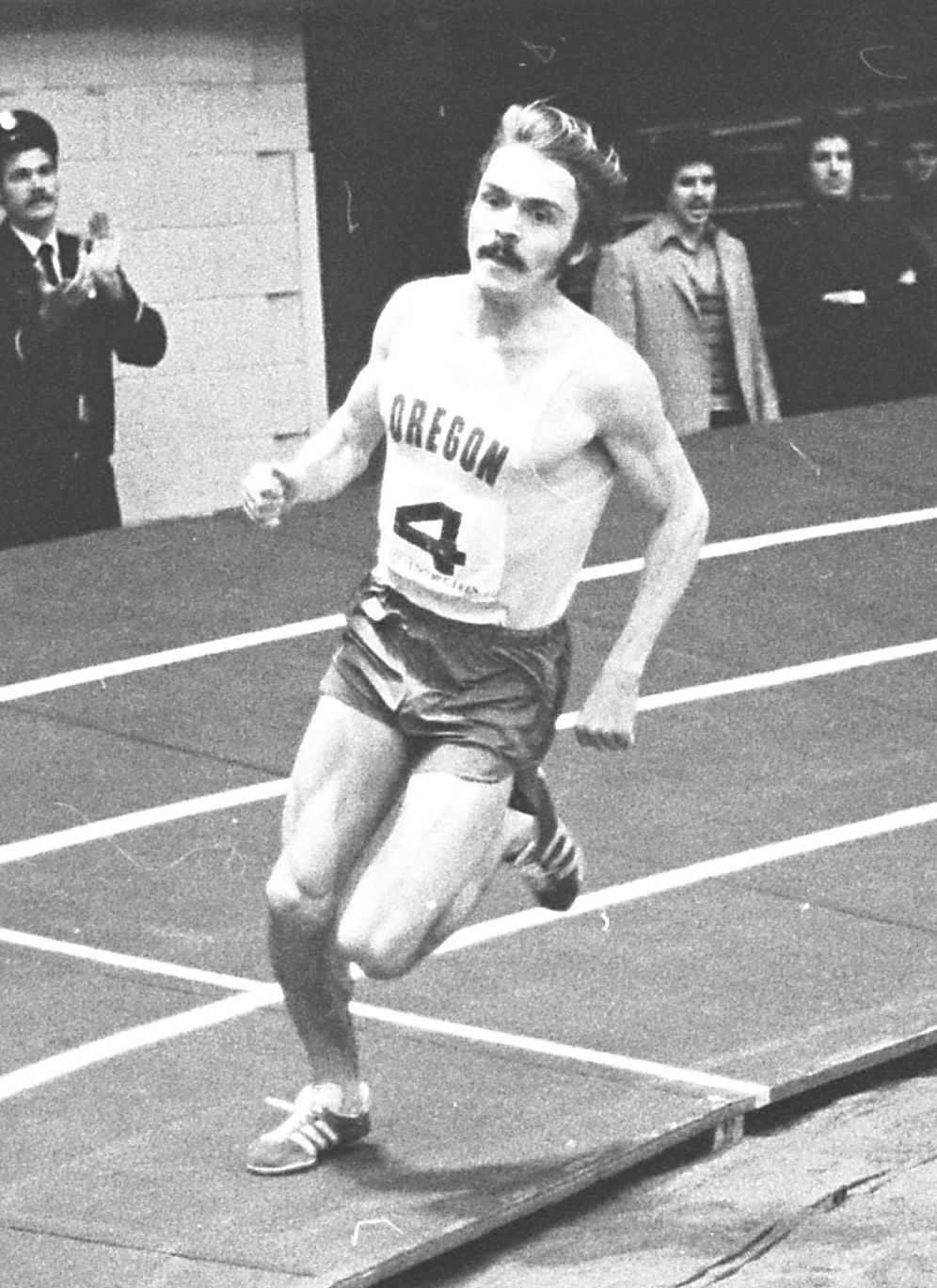
Steve Prefontaine pulls away in the final turn to win the mile in 3:59.2, while Marty Liquori, running behind Prefontaine, faded to third as Italy's Gianni del Buono took second. Image Credit: Larry Sharkey, Los Angeles Times, Wikipedia- https://digital.library.ucla.edu/catalog/ark:/21198/zz0002p4fs
Steve Prefontaine never chased popularity. He just refused to be ordinary. And America couldn’t look away.
I was at practice when my friend Bryan Hoddle found me.
“Did you hear the news?” he said. “Pre died.”
I was in shock for a couple of days.
Pre’s poster adorned my bedroom wall. I had a single-minded goal: I was going to Oregon to run where Pre had run. I followed him on television, watched him compete, studied his racing style, and absorbed everything the camera could convey across the miles between Eugene and wherever I was. He was someone I admired deeply as a young runner—proof of what this sport could be and evidence that running was worth dedicating everything to.
That summer, between my junior and senior years of high school, I ran a time of 1:51.7 for 800 meters at the National Junior Olympics in Ithaca, New York. It was 1975. Not long before that race, Steve Prefontaine had died. For anyone who loved track and field during that time, the news was difficult to accept. Prefontaine wasn’t just another runner; he had become the embodiment of American distance running.
That fall, Bill Dellinger came to see me at my high school—just months after the Oregon program had lost its greatest star. He had seen my results from Nationals. He invited me to Eugene on a recruiting trip.
I agreed without hesitation. The reason was simple: that was where Prefontaine had competed.
To understand why Steve Prefontaine connected with people so deeply, it's essential to consider the state of the country during the time he was running. In the early 1970s, America was not filled with hope. The Vietnam War had shattered the national spirit, and the Watergate scandal had revealed corruption at the highest levels of power. The 1972 Munich Olympics, where Prefontaine competed, were tragically marred by the murder of eleven Israeli athletes. Young Americans, in particular, grew up witnessing the failure of the institutions they were told to trust. As a result, trust became a rare commodity in the nation.
In that fractured landscape, a kid from Coos Bay, Oregon, emerged—a working-class fishing town on the Pacific coast. His father was a welder who had served in World War II, and his mother was a seamstress who grew up in Germany. He wasn't polished or careful; he was direct, competitive, occasionally brash, and entirely himself in every situation he entered. In an era when the country was weary of pretense, Steve Prefontaine didn’t pretend to be anything other than himself.
He grew up trying football and basketball, neither of which had a place for someone his size. Running did. By his junior year at Marshfield High School in Coos Bay, he was undefeated in cross country and track. By his senior year, he had set a national high school record in the two-mile. Forty colleges recruited him. He chose Oregon, and coach Bill Bowerman, and a life that would be short and permanent.
"In an era when America was exhausted by pretense, Steve Prefontaine didn’t pretend at anything".
The people who knew Steve Prefontaine best—his teammates, coaches, and rivals—described him in ways that went beyond just his athletic performance. Those close to him noted that he approached life the same way he approached competition: with confidence and authenticity. To his teammates at the University of Oregon, he was easygoing and simply one of the guys. He lived in a trailer on the outskirts of Eugene, grew his own vegetables, and often took his dog to class. He competed at a world-class level while managing on a tight budget, and he seemed completely unfazed by the contrast between his lifestyle and that of others.
On the track, he was something else entirely. He ran from the front—not because tactics always demanded it, but because he believed it was the most honest way to compete. He said it plainly: he wasn’t interested in finding out who was fastest. He wanted to find out who had the most guts. That wasn’t a marketing line. It was a philosophy. And 15,000 people would pack Hayward Field in Eugene, not knowing whether they were about to see a record or a heartbreak, and they came anyway, because either way it would be worth watching.
Biographer Brendan O’Meara, who conducted more than 150 interviews with people who knew Prefontaine for his recent biography, described a man with an extraordinary gift for making everyone in the room feel like the most important person there. He had a magnetism baked into him—the ability to connect across every divide. He appealed equally to the counterculture left and to the working-class right, to university students and to Oregon loggers and dockers. He was, in the words of author Ken Kesey, not just a name. He was in a condition.
He volunteered at a junior high school. He started a running club at the Oregon State Prison, visiting on his own time and treating the inmates—as one of them later recalled—like regular people, sitting down to talk about life rather than simply handing out a program. He organized his own international track tour, bringing Finnish athletes to Eugene to compete in front of his home crowd. He personally sent shoes with handwritten notes to elite runners across the world. Everywhere he went, he made people feel that running mattered and that they mattered.
“Some people create with words or with music or with a brush and paint. I like to make something beautiful when I run.” — Steve Prefontaine.
One of the most underappreciated dimensions of Prefontaine’s legacy is his activism. The Amateur Athletic Union—which governed American track and field—operated on a system that kept athletes financially powerless. Runners were required to remain amateurs to preserve Olympic eligibility. At the same time, the AAU collected appearance fees for international competitions and distributed almost nothing back to the athletes who made those events worth watching. American Olympians at major international meets received a few dollars a day. Prefontaine lived in a trailer on a minimal income, training at a world-class level, while the organization that controlled his career treated him as an asset rather than a human being with rights.
He said so. Loudly. He testified before Congress. He organized. He pushed. As O’Meara’s biography makes clear, his fight was not primarily about personal financial gain. It was about the principle that athletes deserved to control their own competitive lives—to race against the best in the world on their own terms. He was, in that sense, a forerunner of a world where athletes would eventually earn far greater self-determination. The system that exists today for American track and field athletes is built, in part, on ground he broke before his twenty-fifth birthday.
That fight gave his story a moral weight that pure athletic performance could never have provided alone. People who had never watched a track meet knew who Steve Prefontaine was, not just because he was fast. Because he stood for something.
When I arrived in Eugene that fall of 1975, the loss was still close. You could feel it in the way people talked about him—always with respect, and something more than respect. Something closer to the way a family carries a person who is gone but not fully absent.
One day, I ran along the beautiful roads beside the McKenzie River with the University of Oregon runners on my recruiting trip. For a high school runner, it was an unforgettable experience. I was simply a young athlete who loved the sport, yet there I was running beside some of the best distance runners in the country, in the town where Steve Prefontaine had become a legend. During those runs and conversations, his name came up again and again—always with the same quality of feeling, the way a presence shapes a place long after it is gone.
The mark he had left was everywhere. By the time he died at twenty-four, Prefontaine held every American outdoor record from 2,000 meters through 10,000 meters—eight records in all. He had won seven NCAA national titles. He had never lost a collegiate track race longer than a mile. He had finished fourth at Munich in the 5,000-meter final—at twenty-one years old, two years younger than anyone else in the field—having led with 600 meters remaining, only to be overtaken in the final straightaway. He competed not for a medal, not for safety, but for first—the only way he knew how.
In the end, I didn’t go to Oregon. Running and life took me in a different direction. But that visit remains one of the most meaningful experiences of my running life. For a brief time, I had the chance to connect with people who had trained alongside Steve Prefontaine, raced with him, and been shaped by his example. That connection has always felt like a gift.
'His name came up again and again—always with the same quality of feeling, the way a presence shapes a place long after it is gone".
Historians attribute the running boom of the 1970s to several key factors: Frank Shorter winning a gold medal at the Munich Olympics, Bill Rodgers' dominance in road racing, and the surge of popular books about running that emerged during that time. While all of these contributions are significant, the emotional core of the movement—the individual who made running feel meaningful before most Americans had even put on a pair of training shoes—was Steve Prefontaine.
Nike was still a nascent company when Prefontaine became their first celebrity endorser in 1974, but it has since grown into one of the most recognized brands in the world. Prefontaine's influence on that journey extended far beyond a mere contract. According to Nike’s archives, he visited high schools and running clubs with early Nike employee Geoff Hollister, jogging with students and discussing their goals, making the sport feel both accessible and urgent. He also sent shoes and handwritten notes to elite runners around the globe, fostering relationships and promoting a culture of genuine connection that became fundamental to how Nike presented itself to athletes.
When Pre died, tens of millions of Americans were already seriously considering running. His death did not hinder this movement. In a painful yet paradoxical way, it gave the running boom a focal point—a name to honor and a standard to strive toward.
I have dedicated over fifty years to this sport—as a runner, a coach, and a student of its history. I firmly believe that Steve Prefontaine connected with more people, on a deeper level, than any American runner in history. This connection isn't due to his records, but rather because of who he was as a person.
Most exceptional athletes are admired, but Steve Prefontaine was loved. There's a distinction between these feelings. Admiration arises when you witness someone accomplishing something extraordinary, while love develops when someone's presence makes you feel less alone in the world. Prefontaine had that unique quality. He ran as if each race was a conversation with all those watching—a conversation about courage, honesty, and the refusal to take the easy route when it comes to protecting oneself.
He never won an Olympic medal, nor did he ever hold a world record. Yet, fifty years after his death, the Prefontaine Classic continues to attract elite athletes from around the globe to Eugene each year. Pre’s Rock—the basalt outcropping on Skyline Boulevard where his car came to a rest on the night of May 30, 1975—remains one of the most visited sites in American running. Runners leave their shoes, race bibs, medals, and handwritten notes honoring a man they never met. They come not to commemorate a record, but to celebrate a way of life.
Two Hollywood feature films were made about his life, as well as a documentary narrated by Ken Kesey. Biographies continue to appear, including a major new one in 2025 built on more than 150 interviews. His name is invoked a half-century after his death to introduce his story to an entirely new generation.
That is not an athletic celebrity. That is a life that became a standard.
"Most great athletes are admired. Pre was loved. There is a difference".
When I return to Eugene, I make a point to stop at Pre’s Rock.
There are usually flowers there. Often, race bibs. Sometimes a pair of running shoes is left behind by a visiting runner who wanted to leave something, even though they knew no one would see them do it.
Standing there always brings back memories of that recruiting trip—the runs along the McKenzie River, the conversations, the particular quality of loss that still hung over Eugene that fall. The sense of how completely one person had shaped a place and a sport.
I never got to watch him race in person. Like most of the country, I knew him through a television screen. And that, in its own way, is the truest testament to what he built. He did not need you in the same room. He reached you wherever you were. He made it personal from a distance—which is the only way a runner becomes a legend.
In my lifetime, no American distance runner has been loved the way Steve Prefontaine was loved. And even now, decades after his death, runners still feel the pull of the example he left behind.
He never ran to survive. He ran to matter.
He still does.
Blessings,
Coach Weber
Philippians 4:13
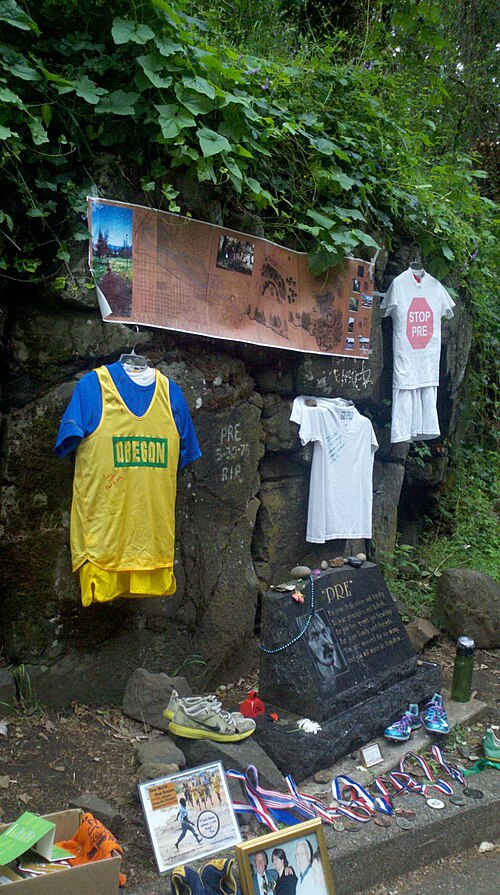
Prefontaine's Rock in Eugene, Oregon. Image credit: By Piratejosh85 at English Wikipedia, CC BY-SA 3.0,
About the Author
Coach Larry Weber is the author of Jesus on the Track: A Christian Athlete's Guide to Handling Hard Days, Building Mental Toughness, and Growing in Faith. A 2026 Washington State Cross Country Coaches Hall of Fame inductee, Weber has built 13 state cross-country championship programs, coached USA Olympic Marathon Trials qualifiers, and is the record holder in the Original Ultimate Runner Competition (10 k, 400 meters, 100 meters, a mile and marathon all ran on the same day). He writes about faith, running, and formation at coachweber.org.
Jesus on the Track is available on Amazon.com: Amazon.com: JESUS ON THE TRACK: A Christian Athlete's Guide to Handling Hard Days, Building Mental Toughness, and Growing in Faith eBook : Weber, Larry: Kindle Store
Coach Weber is also the author of the just released book: Mile Three: How the Hardest Part Builds the Best Kids
Both books are available on Kindle and in paperback.