The Swedish Cardiovascular Study

1.9 MILLION TEENAGERS. 40 YEARS. ONE FINDING THAT CHANGES EVERYTHING.
If you have a teenager, you need to know about this research.
Between 1968 and 2005, Swedish researchers did something extraordinary: they tested the cardiovascular fitness of virtually every 18-year-old male in the country—1.9 million teenagers total.
Then they tracked them for forty years.
They watched who stayed healthy and who didn't. Who thrived and who struggled. Who developed the disease, and who remained strong.
HERE'S WHAT THEY DISCOVERED:
The single best predictor of health at age 60 wasn't genetics. It wasn't family wealth. It wasn't education level or test scores.
It was cardiovascular fitness at age 18.
Let that sink in.
What your teenager does with their body RIGHT NOW—at 15, 16, 17, 18—predicts their health outcomes for the next 50+ years.
THE NUMBERS ARE STUNNING:
Teenagers with HIGH cardiovascular fitness at 18 had:
✅ 50% lower risk of dying from any cause by age 60
✅ 65% lower risk of cardiovascular disease across their entire adult lives
✅ 70% lower risk of Type 2 diabetes—even among those with normal body weight
✅ 74% lower risk of severe depression over four decades
✅ Significantly higher cognitive performance—better memory, faster processing, stronger executive function across their entire lifespan
✅ Greater educational attainment—more likely to complete college, pursue advanced degrees, and enter professional careers
BUT HERE'S THE PART THAT SHOCKED ME MOST:
When researchers compared identical twins—same genes, same family, different fitness levels—the fitter twin still performed better cognitively and had better health outcomes.
This isn't just about genetics. Fitness itself changes your brain and body in ways that protect you for decades.
NOW HERE'S THE CRISIS:
Today's teenagers are the most sedentary generation in human history.
Only 24% of adolescents meet the recommended 60 minutes of daily physical activity.
The average teenager spends 7-8 hours a day on screens and less than 30 minutes in moderate physical activity.
Meanwhile, rates of teen anxiety and depression have surged 40% since 2011. Mental health services are overwhelmed. Waitlists are months long. Parents feel helpless.
We're running an experiment we didn't choose to run:
What happens when you raise an entire generation without the movement their brains and bodies desperately need?
The Swedish research shows us exactly what happens. And it's not good.
THE GOOD NEWS? THIS IS FIXABLE.
The intervention that protects your teenager for 70 years costs about $100 (running shoes).
It requires:
- No prescription
- No insurance approval
- No months-long waitlist
- No expensive equipment or facilities
Just consistent aerobic training.
Cross country. Track. Regular running. 5-6 days a week. Conversational pace. Building the foundation that lasts a lifetime.
This isn't about becoming an elite athlete. It's about showing up consistently and moving your body in ways it was designed to move.
THE MECHANISM:
When teenagers engage in regular aerobic exercise, their bodies and brains undergo profound changes:
🧠 Brain-derived neurotrophic factor (BDNF) production increases—scientists call it "fertilizer for neurons." It enhances the brain's ability to form new connections and adapt to challenges.
❤️ Cardiovascular efficiency improves—the heart becomes stronger, resting heart rate drops, and oxygen delivery to all organs increases.
⚡ Mitochondrial density increases by 40-50%—the cellular powerhouses that produce energy multiply, making the entire body more efficient.
🦴 Bone density increases during adolescence and peaks in the twenties—the density achieved now predicts fracture risk at 70.
🧘 Stress response systems recalibrate—the nervous system learns to handle pressure more effectively, recover faster from challenges, and maintain emotional stability.
All of these compounds have been studied over the decades. The foundation built at 17 protects them at 77.
HERE'S WHAT I'VE SEEN IN 15 YEARS OF COACHING:
The anxious kid who couldn't sit through a test becomes the one who handles pressure with grace over time.
The depressed kid who couldn't get out of bed becomes the one who shows up at 6 a.m. for optional workouts.
The scattered kid who couldn't focus for thirty minutes becomes the one who maintains discipline across all areas of life.
Running didn't cure their challenges. But it gave them tools to manage them. The team became their anchor when they worked on it in positive, life-giving ways. The miles became part of their therapy. The formation became their foundation.
Many are thriving now in college, in careers, in relationships—not because cross country fixed them (they were never broken), but because it taught them they were capable, valued, and loved.
THE QUESTION EVERY PARENT NEEDS TO ANSWER:
Your teenager is either building this foundation right now, or they're not.
They're either:
- Spending 8 hours a week moving their body (building protection for 70 years)
- Or spending that time scrolling through screens (building nothing that lasts)
The watch doesn't lie. The research doesn't negotiate. The consequences compound whether we pay attention or not.
What are they building today that will protect them at 60?
FROM MY BOOK, MILE THREE:
I wrote an entire book about this because I've watched it transform hundreds of teenagers over fifteen seasons of coaching.
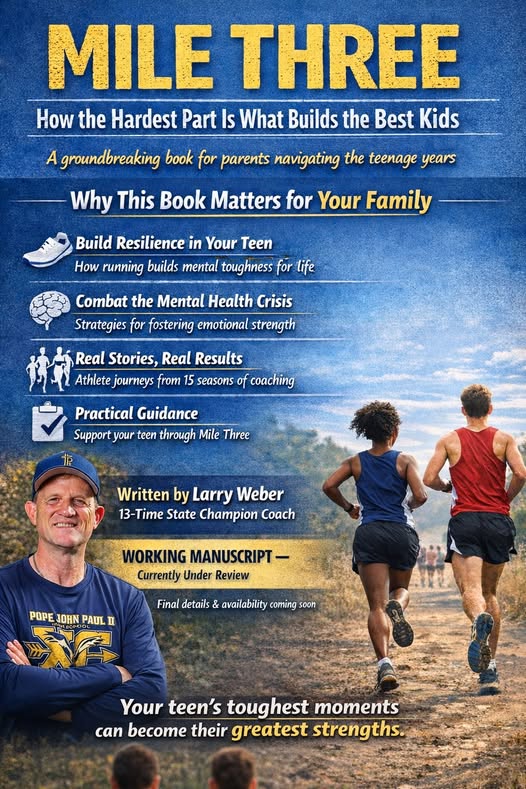
The book is called Mile Three: How the Hardest Part Is What Builds the Best People.
"Mile three" is the last, hardest mile of a cross-country race—where no one is watching, where discomfort is highest, where the finish line is still distant. It's where you discover who you are.
But it's also a metaphor for life. For the hard middles we all face. For the moments when we want to quit but choose to keep going.
The teenagers who learn to push through mile three become the adults who can handle whatever life brings:
- The difficult semester
- The challenging first year of a career
- The relationship conflict
- The health crisis
- The financial setback
- The moments when everything falls apart
They've practiced. They know they can do hard things. They have tools that work.
And it all started with the simple choice to show up and run.
WHAT YOU CAN DO RIGHT NOW:
1️⃣ Talk to your teenager. Show them this research. Ask them: "What are you building right now that will matter at 60?"
2️⃣ Explore cross country or track at their school. Most programs have no tryouts, no cuts. If they show up, they're on the team. No prior experience needed.
3️⃣ Start simple. Even just running 3-4 times a week for 20-30 minutes builds the foundation. It doesn't have to be competitive. It just has to be consistent.
4️⃣ Look for the right program. Not all coaches prioritize formation over performance. Ask the coach: "What do your athletes learn beyond running?" The answer tells you everything.
5️⃣ Give it a full season. The first few weeks will be hard. That's adaptation, not evidence that it's wrong for them. Trust the 8-12 week timeline.
6️⃣ Focus on what matters. Not race times. Not varsity status. Not trophies. Ask instead: "Are they showing up consistently? Are they building discipline? Are they part of a supportive community?"
THE STAKES COULDN'T BE HIGHER:
This generation of teenagers is struggling with unprecedented levels of anxiety, depression, and a sedentary lifestyle.
But we have the research. We know what works. We know what builds protection that lasts.
The question is: will we prioritize it?
Will we make the investment—not of money, but of time and commitment—that shapes the next 70 years of our children's lives?
I hope we will.
Because the teenagers who build cardiovascular fitness at 18 aren't just running faster. They're building bodies that stay healthy, brains that stay sharp, and minds that stay resilient for the next five, six, seven decades.
That's worth far more than any trophy.
LEARN MORE:
📚 Mile Three: How the Hardest Part Is What Builds the Best Kids by Coach Larry Weber (2026)
A comprehensive exploration of how formation through cross-country travel builds physical capacity, mental resilience, emotional regulation, character development, and community connections that last a lifetime.
RESEARCH SOURCES:
- Åberg, M.A.I., et al. (2009). "Cardiovascular Fitness Is Associated with Cognition in Young Adulthood." Proceedings of the National Academy of Sciences, 106(49), 20906-20911.
- Åberg, M.A.I., et al. (2012). "Cardiovascular Fitness in Males at Age 18 and Risk of Severe Depression in Adulthood." The British Journal of Psychiatry, 201(5), 352-359.
- Crump, C., et al. (2016). "Physical Fitness Among Swedish Military Conscripts and Long-Term Risk for Type 2 Diabetes Mellitus: A Cohort Study." Annals of Internal Medicine, 164(9), 577-584.
- Andersen, K., et al. (2015). "Exercise Capacity and Muscle Strength and Risk of Vascular Disease and Arrhythmia in 1.1 Million Young Swedish Men: Cohort Study." BMJ, 351, h4543.
Disclaimer:
Running and exercise are powerful tools for growth, health, and personal development, but every athlete is responsible for listening to their own body. The information shared here reflects only coaching experience and educational insight, not medical advice. Athletes and readers should consult a qualified healthcare professional before beginning or modifying any training program, especially if dealing with injuries or medical conditions. Train smart, progress gradually, and stop immediately if pain, dizziness, or unusual symptoms occur. Always consult a qualified physician before starting any exercise program, no exceptions.
Copyright 2026 Worldwide, Larry Weber