Love in Education: The One Thing That Changes Everything

Years after they scattered into the world—as doctors, lawyers, teachers, engineers, and Ministry leaders—an entire graduating class pointed back to the same teacher. A reporter wanted to know why. Her answer was simpler, and more profound, than anyone expected.
I first heard this story years ago, and it has lodged itself in my memory like a splinter of light—small, but impossible to ignore. It became my informal coaching mission fifteen years ago, and when others ask about our program's focus, I humbly tell them: this is it—pursued imperfectly, of course, but something we always strive for.
It begins at a class reunion. The students, now decades removed from their school days, had become an astonishingly accomplished cohort. Surgeons. Scientists. Engineers. Church leaders. Musicians. The kind of collective success that makes people wonder: What was in the water?
A reporter, intrigued by this improbable concentration of flourishing lives, began digging. He interviewed one alumnus after another, searching for the pattern. And he found it—but not where he expected.
It wasn't the curriculum. It wasn't the facilities or the test scores. It was a person. Again and again, across professions and personalities, they named the same teacher. She had taught different subjects to different students in different years, yet somehow, she had become the common thread in all their stories. Not the only influence, certainly—but the most important one.
When the reporter finally sat down with her, he came armed with hypotheses. Was it a revolutionary pedagogy? An innovative classroom structure? Some cutting-edge method that could be bottled and sold?
She listened patiently to his questions, then smiled.
"I just loved those kids," she said.
That was all.
No formula. No system. Just love.
But not the vague, sentimental kind we toss around so easily. This was something else entirely—something older, deeper, and more demanding. The kind of love that shows up when it's inconvenient. That learns a child's story and remembers it. That celebrates small victories and corrects with gentleness. That refuses to give up when a student stumbles, because it sees not just who they are, but who they are becoming.
Her students didn't just learn math or grammar in her classroom. They learned that they mattered. And somehow, mysteriously, that knowledge carried them through life. At the root of her success, love in education really did win.
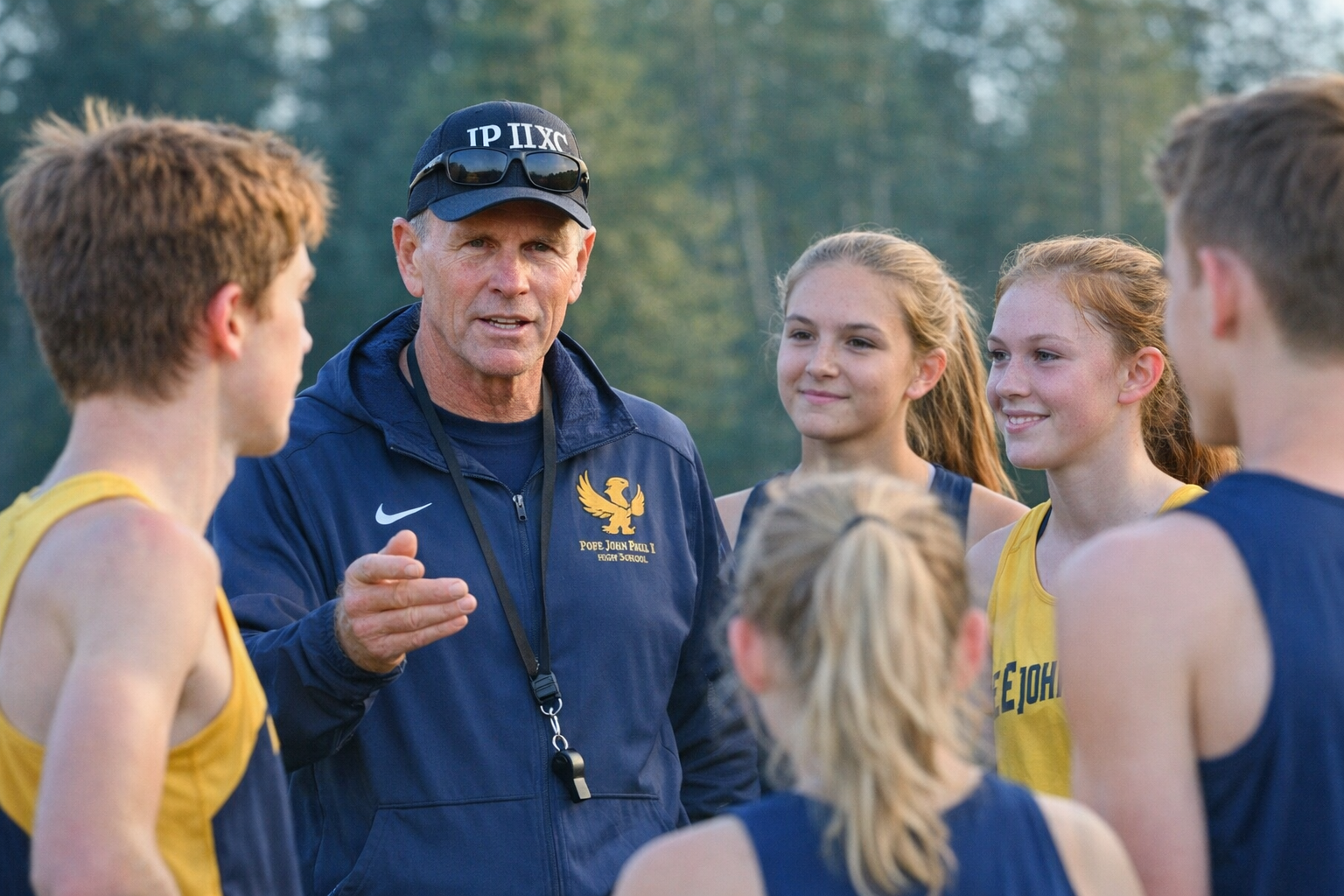
Encouragement and personal connection with students-athletes matter.
The Architecture of the Soul
Scripture gives us a word for this kind of love: caritas—or in Greek, agape. It's not mere affection or sentiment. It's the self-giving, Christ-shaped love that wills the good of the other—not because they've earned it, but because they exist. Because they bear the image of God.
This is the love described by St. Paul in his letter to the Corinthians: patient and kind, not envious or boastful, bearing all things, believing all things, hoping all things, enduring all things. It's the love that "never fails"—not because it always succeeds in worldly terms, but because it participates in something eternal.
Scripture teaches this isn't theological poetry. It's the foundation of human dignity. Before a child solves a single equation or wins a single race or earns a single accolade, they already possess infinite worth. Not because of what they can do, but because of whose they are.
That teacher understood this at a bone-deep level. She didn't love her students because they were brilliant or compliant or destined for greatness. She loved them because they were hers to love—entrusted to her care as living icons of the divine. And in loving them that way, she reflected something of the love God has for each of us: relentless, unearned, transformative.
This is what the world so often misses. We treat love as a feeling to be managed or a reward to be earned. But agape is a decision—a daily choice to see the sacred in the ordinary, the eternal in the temporary, the image of God in every stumbling, striving child.
What the Greatest Commandment Means
When a lawyer type once tried to test Jesus, asking him which commandment was the greatest, Christ's answer was unequivocal:
"He said to him, 'You shall love the Lord, your God, with all your heart, with all your soul, and with all your mind. This is the greatest and first commandment. The second is like it: You shall love your neighbor as yourself. The whole law and the prophets depend on these two commandments.'" (Matthew 22:37-40, NABRE)
The whole law and the prophets. Everything. Every moral teaching, every spiritual discipline, every act of worship—it all hinges on love, not as an abstract ideal, but as a concrete practice: loving God with our whole being, and loving the person in front of us as we love ourselves.
Notice the order. We love God first, and from that primary love flows our love for others. This isn't incidental. When we try to love people without rooting that love in God, we exhaust ourselves. We burn out. We become resentful when our love isn't returned or appreciated. But when our love for others is an overflow of our love for God—when we see Christ in the face of the child before us—that love becomes inexhaustible. It draws from a source that never runs dry.
That teacher, whether she articulated it this way or not, had discovered this truth. Her love wasn't sustained by her own natural reserves or the gratitude of her students. It was sustained by something transcendent—by the recognition that in serving these children, she was serving Christ himself. "And the king will say to them in reply, 'Amen, I say to you, whatever you did for one of these least brothers of mine, you did for me.'" (Matthew 25:40, NABRE)
This is the secret hiding in plain sight: the most powerful force in education, in coaching, in parenting, in any work of formation—is love. Not a soft, indulgent love that demands nothing and overlooks everything. But a strong, sacrificial love that calls forth the best in another because it first sees the best in them.
Why Love in Education Transforms Every Child
We live in an age obsessed with metrics. Test scores. Win-loss records. College acceptance rates. Résumé builders. These things aren't worthless—but they're not ultimate. And when we organize our children's lives around them, we risk missing what matters most.
When you're choosing a school, a team, or a program for your child, ask different questions. Don't just ask about facilities, championships, or average SAT scores. Ask about the people. Ask yourself: Are there adults here who will love my child?
Not adults who will use my child to inflate their own ego or pad their own record. Not adults who will see my child as raw material to be processed or a blank slate to be filled. But adults who will see the irreplaceable, unrepeatable gift that this particular child is—and who will help them become who they were created to be.
Look for places where love flourishes, where teachers know students' names and stories, where coaches correct with respect and celebrate effort as much as outcome, where mentors stick around when things get hard. Where people are valued for their inherent dignity, not just their performance.
Because here's what I've learned in fifteen years of coaching: kids remember how you made them feel long after they've forgotten what you taught them. They might not recall your training plans or your speeches. But they remember whether you believed in them. Whether you saw them. Whether you loved them. Whether you apologized when you made a mistake.
This isn't sentimentality. It's neuroscience, psychology, and Scripture converging on the same truth: we become who we are loved into being. When a child experience true agape—love that is patient, sacrificial, and rooted in their God-given dignity—something shifts. A door opens. They begin to believe that they matter, that they have purpose, that they are capable of more than they imagined.
Sometimes one person's belief in a child becomes the hinge on which an entire life turns.
The Courage to Love
Let's be honest: loving this way is costly. It requires time we don't have, patience we've run out of, and hope in the face of discouragement. It means showing up when we're tired. Trying again when we've failed. Believing in potential we can't yet see.
St. Paul knew this. In that same letter where he describes love so beautifully, he also writes: "It bears all things, believes all things, hopes all things, endures all things." (1 Corinthians 13:7, NABRE) Believes. Hopes. Endures. These are not passive verbs. They require strength. They require grace.
We will never love perfectly. Only God loves perfectly. But we are called to love anyway—to participate in God's love, to be conduits of it, even in our brokenness. This is the heart of Christian vocation: whatever our role—parent, teacher, coach, mentor—we are called to reflect Christ's love to those in our care.
The remarkable thing is that when we do this, even imperfectly, we participate in something eternal. We help no matter how small in the formation of souls. We help children discover not just what they can do, but who they are. Beloved. Unrepeatable. Made in the image of God. Destined for greatness not because of their achievements, but because of their calling.
The Legacy That Lasts
That teacher from the reunion story didn't set out to change the world. She chose, day after day, to love the children in front of her. And decades later, her students—now scattered across professions and geographies—carried that love with them. They became doctors who saw patients as people, not cases. Teachers who remembered what it felt like to be seen and loved. Leaders who treated others with dignity.
Her love multiplied. It echoed. It became part of the architecture of dozens of lives, and through them, touched hundreds or thousands more.
This is the mathematics of agape: it never diminishes. It only grows.
So here is my invitation to you, whether you are a parent, teacher, coach, or anyone who works with young people: Just love those kids. Love them with the patient, sacrificial, Christ-centered love that sees their infinite worth before they've proven anything. Love them on hard days. Love them when they fail. Love them into becoming who God created them to be.
Because, at the end of all our strategies, programs, and carefully constructed plans, love is what changes everything.
Love is what lasts.
And love—when it flows from the heart of God through our imperfect hands—is how champions of character are made.
"I can do all things through him who strengthens me."
—Philippians 4:13, NABRE
Coach Larry Weber has had the privilege of leading teams to 13 state championships in cross-country and two in Track and Field over the past 15 years. For the last nine years, he has been the head coach at Pope John Paul II High School in Lacey, Washington. This year, he is honored and grateful to be inducted into the Washington Coaches Cross Country Hall of Fame in 2026.
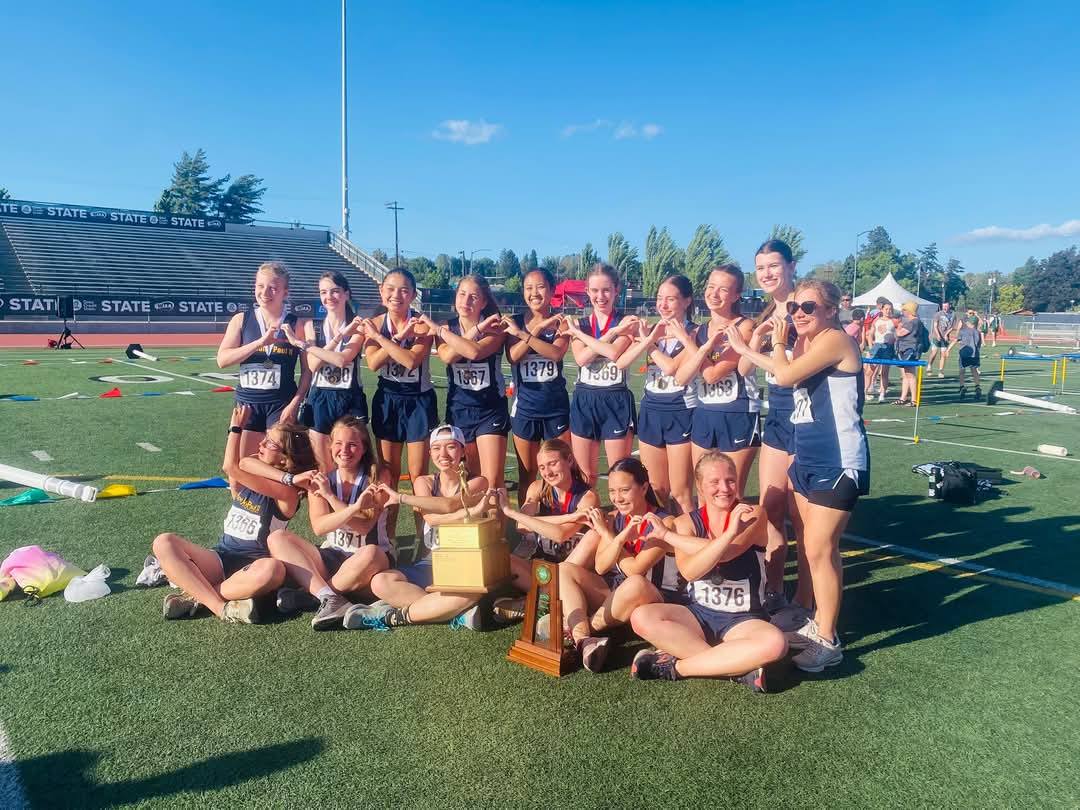
The Pope John Paul II girls' team after winning the state track and field championships in 2025.