The Lonely Place
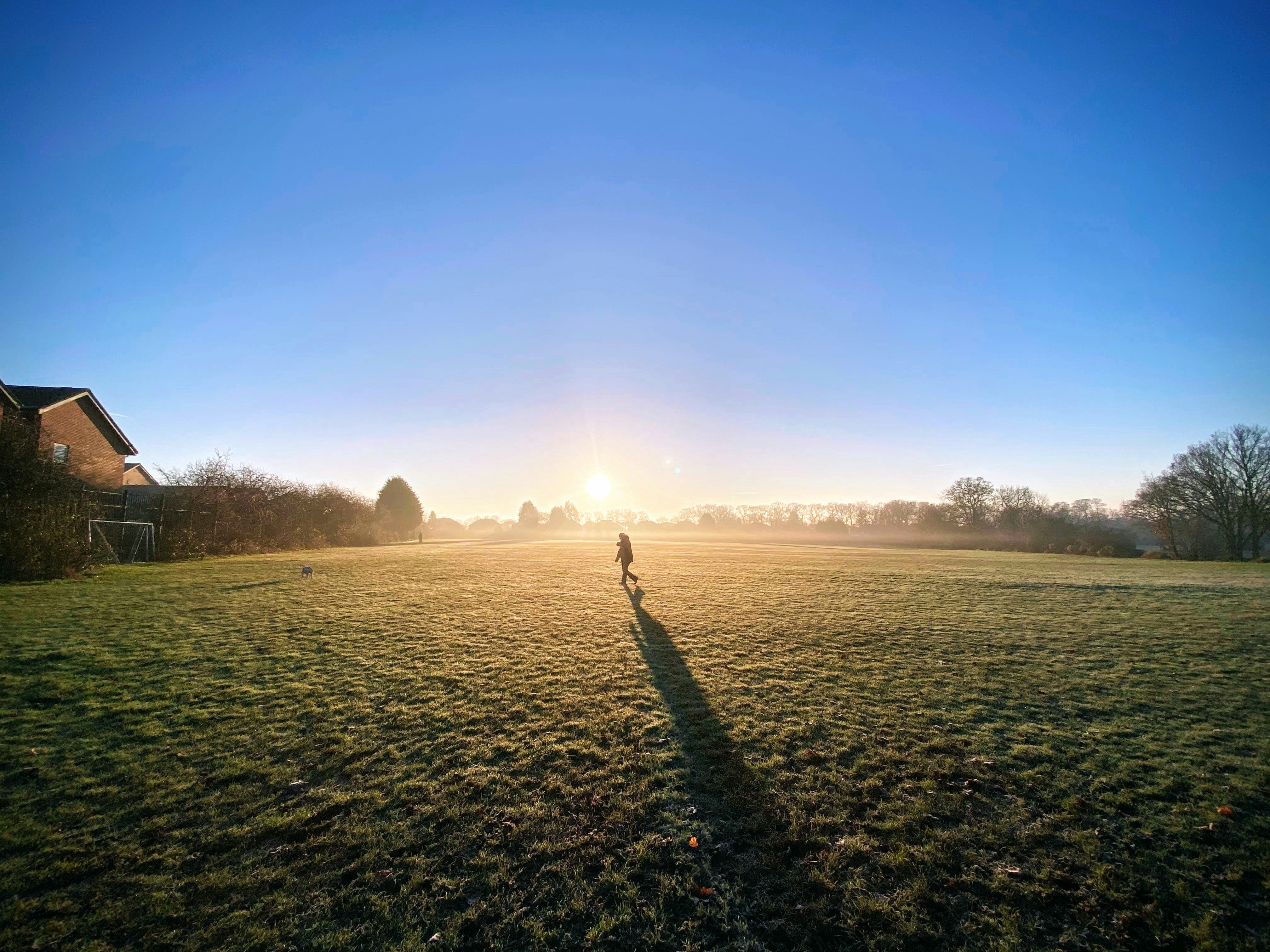
Image Credit: David Clark, Unsplash
If Jesus Needed to Recharge and Reset, So Do We — And That Changes Everything
I have coached cross country and track for a long time. In some seasons, I realized that while I dedicated myself to my athletes and we won state championships, I wanted to give more to God. The workouts were well-designed, and the team culture was strong, but I felt like I could do better in my spiritual commitments. I was running on fumes, with little else to give.
Maybe you know the feeling. Not a dramatic crisis of faith. Just… dry. A little hollow. Giving from a place that did not have much left to give.
I came across Henri Nouwen’s short book Out of Solitude during one of those seasons. Nouwen was a Dutch Catholic priest who taught at Harvard and Yale and then gave it all up to live among people with developmental disabilities in Canada. He spent his life writing about the interior life — not as an abstract spiritual concept, but as the most practical thing a human being can tend to.
His book builds its case on three moments from Jesus's life. And what struck me, reading it in a quiet room after a long week, was not the theology. It was the permission.
Here is the hope at the heart of this post, and I want you to receive it before you read anything else: Jesus needed the lonely place. Which means your need for it is not a failure. It is not a weakness. It is not a sign that your faith is inadequate. It is the most human thing about you — and Jesus shared it.
Scripture 1 — Before Dawn, a Lonely Place
“In the morning, long before dawn, he got up and left the house, and went off to a lonely place and prayed there.” — Mark 1:35
The day before this verse, Jesus had the most exhausting day of his ministry. Healings, crowds, demands. Everyone wanted something from him. He gave and gave and gave. And his response to a day of total output was not to sleep in, not to push through, not to be strong about it.
He got up before dawn and went somewhere alone to pray.
Nouwen’s insight here is not that Jesus was an introvert who needed to recharge his personality. It is something more radical: Jesus was returning to the source. The action of the previous day flowed from his relationship with the Father. And that relationship required tending — daily, deliberately, honestly, before the demands of the next day began.
Not performance prayer. Not saying the right words to satisfy a spiritual obligation. Honest prayer. The kind where you come to God as you actually are — tired, empty, not sure what to say — and remain long enough to be with him before the world starts asking things of you.
I think about the Scriptures that have carried me through hard stretches. Isaiah 40:31: Those who wait on the Lord will renew their strength. Psalm 23: he leads me beside still waters, he restores my soul. These are not verses for people who have it together. They are provisions for dry people. They were written for people like us, in seasons like this one.
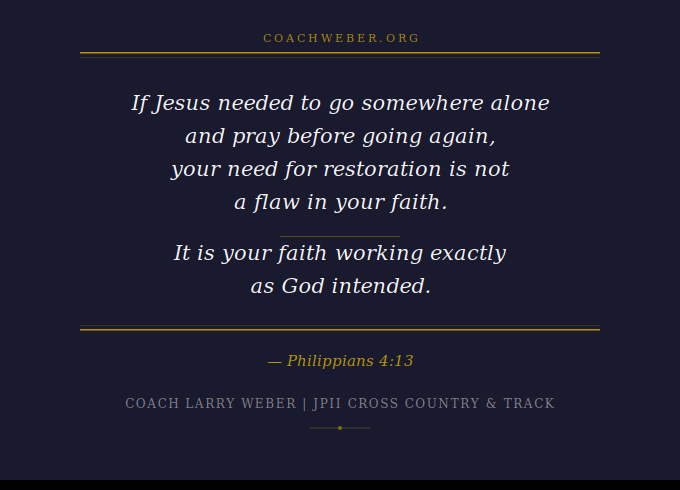
If the Son of God needed to go somewhere alone and pray before going again, your need for restoration is not a flaw in your faith. It is your faith working exactly as God intended. We all need to recharge and reset.
The lonely place is not laziness. It is the precondition for everything else. For the coach, the parent, the teacher, the athlete — whatever we pour out, we can only pour from what we have first received.
Scripture 2 — Before the Five Thousand
“He said to them, ‘Come away to a deserted place all by yourselves and rest a while.’” — Mark 6:31
Before Jesus fed five thousand people — one of the most famous miracles in the Gospels — he tried to pull his disciples away from the crowd first. They had just returned from their own mission tour. Tired, full of stories, probably still running on adrenaline. The crowd was pressing in. And Jesus said: Come away. Rest a while.
Nouwen uses this scene to make a distinction that I have found both convicting and deeply freeing. The distinction is between curing and caring.
Curing is fixing. Caring is being present. Curing keeps you safely on the outside of another person’s pain, managing it efficiently from a distance. Caring requires you to step inside it with them — to actually feel what they are carrying, not just solve it.
Most of us default to curing. It is faster. It is more comfortable. It lets us feel useful without having to be vulnerable. We give advice, we offer solutions, we find silver linings — and we call it helping. But Nouwen argues, gently and precisely, that what people most need is rarely the answer. It is the presence.
And here is the part that changed how I think about my own formation: the capacity for genuine presence only comes from people who have learned to sit honestly with their own pain before God. Solitude is where that happens. When you stop running from yourself and bring your real self to prayer — tired, dry, frustrated, uncertain — you discover that God does not leave. That suffering is survivable, that you are still there on the other side.
And once you know that from the inside, you can offer it to someone else. You stop needing everyone around you to be okay, because you have stopped needing yourself to be okay. You can be with people. You can care.
You don’t have to have the answers to be what someone needs. You have to be willing to stay. And that willingness is built in the lonely place, one honest prayer at a time.
Scripture 3 — Sorrow Turned to Joy
“So you have pain now; but I will see you again, and your hearts will rejoice, and no one will take your joy from you.” — John 16:22
Jesus said this to his disciples the night before he died. Not a pep talk. Not a promise that the hard part would be skipped or softened. He told them plainly: pain is coming. And then he said the thing that has stayed with me for years: the joy waiting on the other side of it cannot be taken from you.
That is not shallow encouragement. That is the promise of someone about to walk into the worst suffering in human history, who kept every word he said when he came out the other side.
Nouwen calls this posture expectation. Not denial, which pretends the pain is not real. Not despair, which decides the pain will never end—expectation — the steady, active, faith-grounded ability to hold sorrow and certainty at the same time.
This is one of the things I most want for the people in my life — athletes, parents, friends. Not that they would avoid hard things. But that they would have somewhere to go when hard things come. That they would have built, through years of honest prayer in the lonely place, a foundation that holds when everything else is shaking.
The Scriptures we bring into suffering are not motivational slogans. They are the voice of someone who has been through worse and kept his promises on the other side. Philippians 4:13. Romans 8:28. Psalm 34:18: the Lord is close to the brokenhearted. These are provisions for the road. They were meant to be carried.
The hard moment does not have the last word. Christ does. And his word is: your hearts will rejoice, and no one will take your joy from you.
The Pattern — and What It Means for You
Three moments. Three movements. Jesus withdraws to a lonely place and prays honestly before the day begins. Out of that depth, he serves the people in front of him with genuine presence, not just efficient output. And when suffering comes — and it comes — he holds it with expectation rather than despair, because he knows where it ends.
That is the full loop. Solitude. Service. Endurance. Joy.
It is also the loop that most of us have been trying to run in reverse. We pour out first and wonder why we are dry. We try to care for people without having sat with our own pain. We try to endure hard things on willpower alone, with no roots to draw from.
Nouwen is not offering a technique. He is pointing at a person — Jesus, who modeled this before he asked anything of us. The lonely place is not a spiritual discipline to add to your list. It is an invitation from someone who went there first, who is already there, who is waiting.
You are not too tired. You are not too dry. You are not too far behind. Jesus was in that dark field before dawn, praying — and he is still there. The invitation is still open. It has your name on it.
What would it look like to accept it today? Not perfectly. Not with the right words. Just honestly, the way Jesus went to the field — before the crowds came, before the demands began, before anyone was watching.
Three minutes. A morning offering. A single verse you carry into the day.
That is the lonely place. That is where everything else comes from.
Scripture references used: NJB version
Coach Weber, Philippians 4:13