The Impossible Race That Taught Me What Real Strength Means
How losing the ability to stand revealed the truth about Philippians 4:13
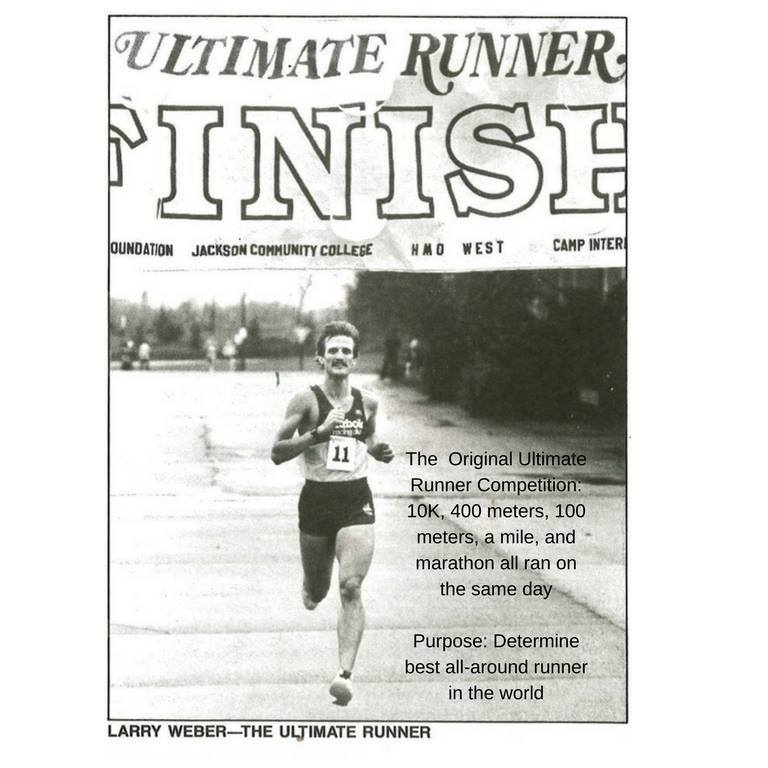
In 1985, I competed in what Runner's World Magazine called "the last word in endurance running"—the Original Ultimate Runner Competition. Five races in one day: a 10K, 400 meters, 100 meters, a mile, and a marathon. The winner would be crowned the best all-around runner in the world.
Olympians, American record holders, and elite marathoners competed over the years. Barney Klecker held the American 50-mile record. Dave Hinz had run a 2:12 marathon. John Craig was a former 1500-meter Olympian. I ran against all of them that year.
Nobody knew my name. I was a middle-distance runner from Olympia, Washington, who'd trained alone after my Olympic Trials dream died with a torn glute. I was ranked number 11 going into the event.
My Strategy
I had a theory: milers make the best all-around runners. We have both speed and endurance—the perfect intersection for this absurd challenge.
I ran the 10K conservatively, finishing fourth while feeling fresh. An hour later, I beat John Craig in the 400 meters. Then came the 100—where I discovered my sweats were soaked and the drawstring stuck. I had to run the sprint in water-logged pants. I still finished second.
In the mile, I stayed with Craig until the final 60 meters, then deliberately eased up. Not because I was tired—because I was saving that burst for mile 26 of the marathon, not meter 1540 of the mile.
The Marathon
I'd never run a marathon before.
Dave Hinz led the pack out at sub-2:20 pace. Insane speed after four races. I let them go and settled into my own rhythm.
Mile 18. Mile 20. Mile 22.
Then I saw Hinz ahead—the 2:12 marathoner—slowing down. The cumulative toll had caught him. As I passed, I called out: "You've got this, Dave."
Because we were all suffering together.
The Collapse
I crossed the finish line and my legs gave out. Completely.
Officials had to catch me, then physically lift and carry me to the awards platform that day. My legs were literal jelly—non-functional, shutdown, done.
I'd won. The best all-around runner in the world.
And I couldn't stand.
I set the all-time event record. In later years, Olympic marathoners like Don Kardong and Jeff Galloway would attempt the competition, but my record stood.
What I Learned
I'd always understood Philippians 4:13—"I can do all things through him who strengthens me"—as inspirational. God makes you stronger. God helps you succeed.
Standing on that platform (or rather, being held upright intially), I realized I'd been wrong.
God didn't make me stronger that day. My strength completely failed.
But His didn't.
The verse doesn't say "with His help." It says "through Him"—as in, God's strength replacing mine when mine runs out.
2 Corinthians 12:9 says: "Power is made perfect in weakness."
Not adequate in weakness. Not helpful despite weakness. Perfect.
God's power doesn't work despite our weakness. It works because of it.
The Real Victory
I'd spent my entire running career building strength—training harder, running faster, becoming more capable.
But I won that race not when I was strongest, but when I was weakest. When my legs failed. When I had nothing left. When I was being physically carried.
The injury that ended my Olympic Trials dream hadn't been punishment. It had been preparation—God tearing down the idol of self-sufficiency, teaching me that His strength works best when mine fails.
The Ultimate Runner plaque is hidden in a spare room at my home out of site.
But the transformation is permanent.
I learned that day that real strength isn't not falling. Real strength is being willing to be lifted up.
That's why I sign most documents with Philippians 4:13 today.
Not as a motivational slogan. Not as a promise that God will make me successful.
But as a testimony to what I learned when my legs turned to jelly and officials had to carry me to the platform.
A testimony that God's power is made perfect in weakness. That I can do all things not through my own strength, but through Him who strengthens me. That the breaking point isn't the end—it's where real strength begins.
Most emails. Most letters. Every message to an athlete or parent or colleague.
Blessings, Coach Weber, Philippians 4:13.
Because I never want to forget what I learned that day in Michigan.
That when my strength completely fails—and it will—God's doesn't.
Blessings,
Coach Weber
Philippians 4:13