The Ten-Minute Miler Is Also a Champion
If They Give Everything They Have

Photo Credit: Clique Images
He's the last one across the finish line.
Not close to last. Last. The clock keeps running long after the front pack has finished, cooled down, and started congratulating each other. Nobody will screenshot his name in the results tonight. There's no medal waiting, no all-conference mention, no recruiting email. None of that changes what he just did.
Watch his face crossing that line anyway. Arms up. Chest heaving. Nothing left in the tank. That's not a consolation prize. That's the whole race, run exactly the way a race is supposed to be run.
I'll call him Marcus. He's really a composite of dozens of runners I've had the privilege of coaching over the years, from complete beginners to age-group world-record holders and Olympic Trials athletes. I've been coaching young people, in one fashion or another, for decades now, and Marcus represents the ones who never had the raw talent of others on their team.
He's who I want to talk about today: the runners who don't share the great athletic genes that God hands out so unevenly.
Some people have far more innate ability than others. That's simply true, and no amount of positive coaching language changes it. God hands out different gifts in different measure. Some kids arrive with a stride that looks assembled in a lab, lungs that show up ready on the first fitness test, a natural economy of motion the rest of us spend years chasing.
Coach a large enough team, long enough, and you will find some of those kids. That's simple probability. The bigger the pool, the more likely you are to find rare natural talent somewhere in it. Over these decades I've been fortunate to coach state champions, Olympic Trials competitors, and athletes whose records stood for years after they graduated.
But that was never the whole measure of a program, and it's never been mine.
Some of the seasons I'm proudest of didn't have a single Division I or Division II recruit on the roster. Our girls' team at JPII won a state championship in just its second year of existence. Most of that team had never run competitively before they walked onto our roster the year prior. They didn't win because they out-talented the programs they beat. They won because they out-worked what everyone assumed was possible for a team with that little running history behind it.
So what actually makes a champion?
To me, it's someone who learns to give everything they have with the gifts they've been given, whether that's a sub-four-minute mile or a ten-minute mile run with nothing held back.
The four-time state champion training at 5 a.m. and the once-a-week beginner who finally breaks a twelve-minute pace are doing the exact same thing, measured against two different starting points. Same effort. Same worth. I'm not taking anything away from the state champion here. That kid earned every bit of it, and usually worked as hard as anyone on the team to get there. But the size of the trophy was never the whole story, for him or for Marcus.
There's an old story about this, older than any coaching philosophy I've built. In the Gospel of Matthew, a master hands out talents to three servants before leaving on a journey, five to one, two to another, one to the last, "each according to his ability" (Matthew 25:15). He doesn't judge them later by the size of what they were handed. He judges them by what they did with it. The servant who turned two talents into four gets the identical commendation as the one who turned five into ten: "Well done, good and faithful servant" (Matthew 25:21, 23). Nobody in that parable is punished for being handed less. Only for burying what he had, out of fear, or laziness, or the quiet assumption that it wasn't enough to work with.
That's the whole argument, really, two thousand years old and still true on a cross country course on a Tuesday afternoon in October.
The research backs it up as much as the Scripture does. Psychologist Anders Ericsson spent his career studying what actually separates elite performers from everyone else, and it wasn't the gift they started with. It was the depth and consistency of the work they put in over years (1). Talent sets a ceiling. It rarely decides who gets close to it.
I've watched that play out on my own teams for decades: gifted kids who coasted and quit, and kids nobody expected much from who worked themselves into some of the best seasons our program has ever had. Hard work beats talent when talent doesn't work hard. I didn't invent that phrase, but I've watched it prove itself true more times than I can count.
Kids who learn to give everything within their own limits, not somebody else's, carry that habit into everything that comes after the finish line. The discipline. The willingness to be uncomfortable on purpose. Showing up on the days it would be easier not to. Those things transfer into a job, a marriage, a faith, in a way that a fast time never quite does by itself.
Decades ago, my college coach, Marshall Clark, told me something I've never stopped thinking about: "Sacrifice and self-discipline are more than mere words to a champion; they are a way of life if you want to succeed at distance running or any other important goal."
He wasn't really talking about running times. He was describing what it looks like to give everything you've been given, whatever that turns out to be. Coach Clark was right. His words never led me astray.
And Marcus, whoever he really is on your team this fall, already understands that better than most adults ever will. I've coached enough of him, in enough different kids, over enough years, to know that's not sentimental. It's just what's true.
Blessings, Coach Weber Philippians 4:13
End Note
- Anders Ericsson and Robert Pool, Peak: Secrets from the New Science of Expertise (Boston: Houghton Mifflin Harcourt, 2016).
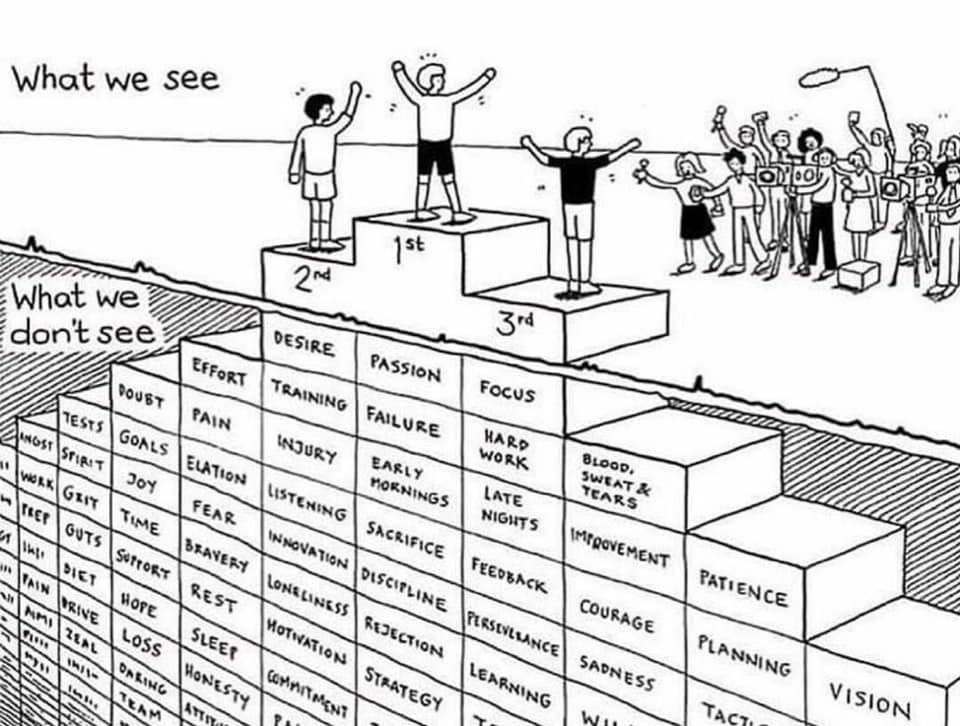
Image Credit: Unknown