The Right to Win Has to Be Earned

I almost didn't sign up.
The 1985 Original Ultimate Runner Competition — a 10K, a 400 meters, a 100-meter sprint, a mile, and a marathon, all run on the same day — was the kind of event that made more sense on paper than in your legs. I wasn't sure I was ready. What I knew was that someone I loved would be watching from the side of the road, and I didn't want to be the version of myself who backed down.
So, I trained. Not because I was confident. Because I was afraid of arriving unprepared for something that mattered.
That day broke me open in ways I still carry with me. Somewhere around mile eighteen of the marathon — after the sprints, after the track intervals, after my legs had already cashed every check my will had written — I learned something I couldn't have learned any other way. Wanting isn't enough. Hoping isn't enough. You have to have paid for it in advance, in the dark, when no one is watching, and quitting would be easy.
I won the competition that day and set a record I never could have predicted. But standing at the finish line, what I felt wasn't pride. It was something quieter — closer to gratitude than triumph. The gifts weren't mine. The strength that carried me through mile twenty-six wasn't something I had manufactured. I had shown up prepared enough for God to work with.
The person watching from the roadside saw all of it — the suffering, the stubbornness, and whatever grace carried me through. That witness meant more than the result.
That's the only version of "deserve to win" that has ever made sense to me.
A Culture That Has Forgotten the Price
We live in a culture that has confused confidence with preparation. Wanting something badly is treated as a form of earning it. Desire, passion, belief — these have value, but they are not the price of admission. They are what get you to the starting line. They don't get you across the finish.
The motivation marketplace is flooded with surefire, painless formulas for success. Don't fall for them. Masses of people do every day, and most of them are still standing at the starting line five years later, wondering why nothing has changed.
The truth is harder and cleaner than any formula: great knowledge does not automatically produce great performance. Being book-smart is not the same as being street-smart. You have to apply what you've learned to reap results. As the old saying goes — Well done is better than well said.
We have enough theorists. We need more people who actually live the work.
What Scripture Has Always Known
St. Paul understood this. He didn't write I can do all things from a chair. He wrote it from prison, from shipwrecks, from beatings, from years of choosing the harder road when the easier one was right there.
"I can do all things through Christ who strengthens me." — Philippians 4:13 (NRSV-CE)
That is not a prosperity promise. It is a testimony from a man who had earned the right to say it.
Solomon wrote the same truth three thousand years ago:
"All hard work brings a profit, but mere talk leads only to poverty." — Proverbs 14:23 (NRSV-CE)
The insight hasn't aged. We keep needing to relearn it. Every generation has to discover that there are no shortcuts to any place worth going.
What the Research Confirms
Performance science confirms what Scripture and common sense have always known. Psychologist Anders Ericsson spent decades studying elite performers — musicians, chess grandmasters, world-class athletes — and found that what separates the exceptional from the merely talented is not innate gift. It is deliberate, effortful practice sustained over years.
The body and mind adapt to stress. But only when the stress is real. Only when you actually show up, day after day, and do the work the goal requires.
Hard work beats talent when talent doesn't work hard. I have watched that sentence come true on tracks, in classrooms, and in boardrooms more times than I can count.
Zig Ziglar — one of the finest communicators of the twentieth century — prepared his speeches for hours before each event. Speeches he had given dozens of times before. He knew that being deserving of a win wasn't a permanent credential. It was something you re-earned, every time, with every audience. No entitlement. No coasting on yesterday's effort.
That's not perfectionism. That's honor.
"Whatever you do, work at it with all your heart, as working for the Lord, not for human masters." — Colossians 3:23 (NRSV-CE)
You do it because the work itself is sacred. Because the people watching — the ones who believe in you — deserve your best.
The Runner Who Forgot
I want to tell you about a runner I coached.
This athlete had been in the national class. Years of grinding, early mornings, painful track workouts, the kind of training that reshapes you from the inside out. It worked. They were genuinely elite. And then life moved on, as it does, and competitive running faded into memory.
Then an Olympic Trials qualifier appeared on the horizon—one more chance. The fire came back.
But something was missing — and I watched it happen in slow motion. This athlete returned to competition believing that what they had been was enough to carry them to what they wanted to become. They had forgotten the price of the previous achievement. They trained, but not with the full surrender the goal required. They believed, but belief alone doesn't build fitness.
They missed the standard.
Not because they lacked talent. Not because they lacked heart. Because they had quietly stopped answering the question that every serious goal demands of us:
Have I actually earned the right to this result?
— — —Grace Is Real — But It Is Not a Substitute
I want to be careful here, because this principle can be distorted.
"Deserve to win" is not entitlement with a work ethic attached. It is not a transaction — put in enough effort, and you will receive what you want. God doesn't work that way, and neither does life. There is always grace. There is always mercy. We are never purely the sum of our preparation.
But consistent entitlement thinking — the assumption that a goal owes us something we haven't paid for — is the quiet killer of excellence. No organization, no team, no athlete, no person improves by consistently lowering the bar. The bar rises when we rise to meet it.
You are a champion, not when you win. You are a champion when you give your best with the gifts you've been given. That is the only finish line that matters. That is the only answer to the question God asks at the end of our race.
I crossed that finish line in 1985, not because I was the most talented in the race, but because I embraced the opportunities that preparation provided. It was through faith and hard work that I reached that moment. The achievement was a gift, and my role was simply to honor it by showing up ready to give my best. In humility, I learned that success is a blend of dedication and the grace we receive along the way.
That's what it means to deserve to win.
Earn it.
Blessings,
Coach Weber
Philippians 4:13
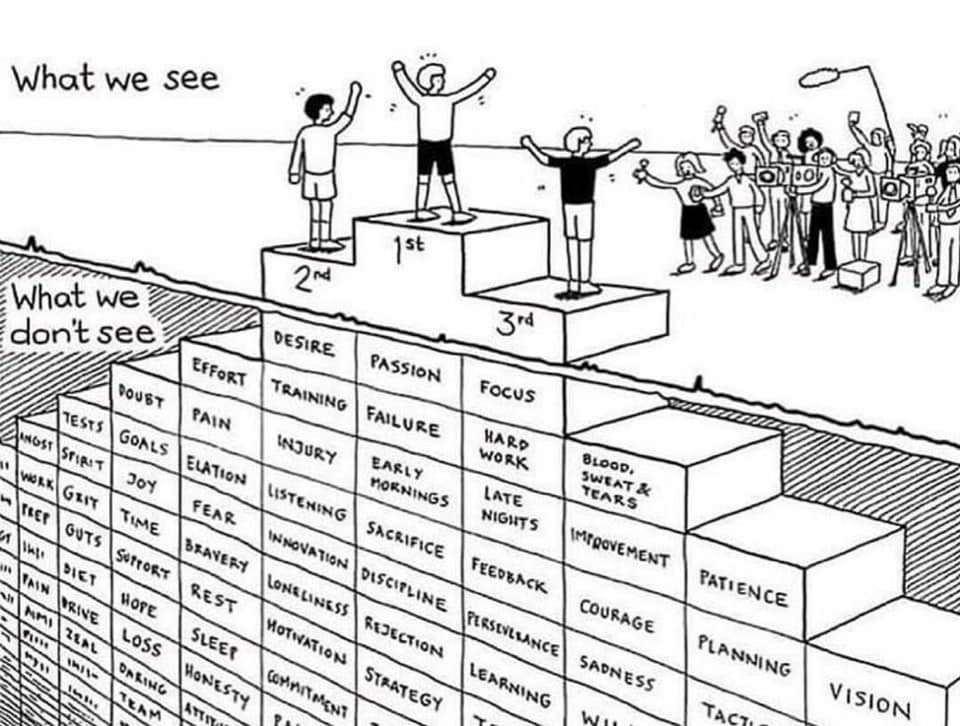
Photo Credit Unknown.