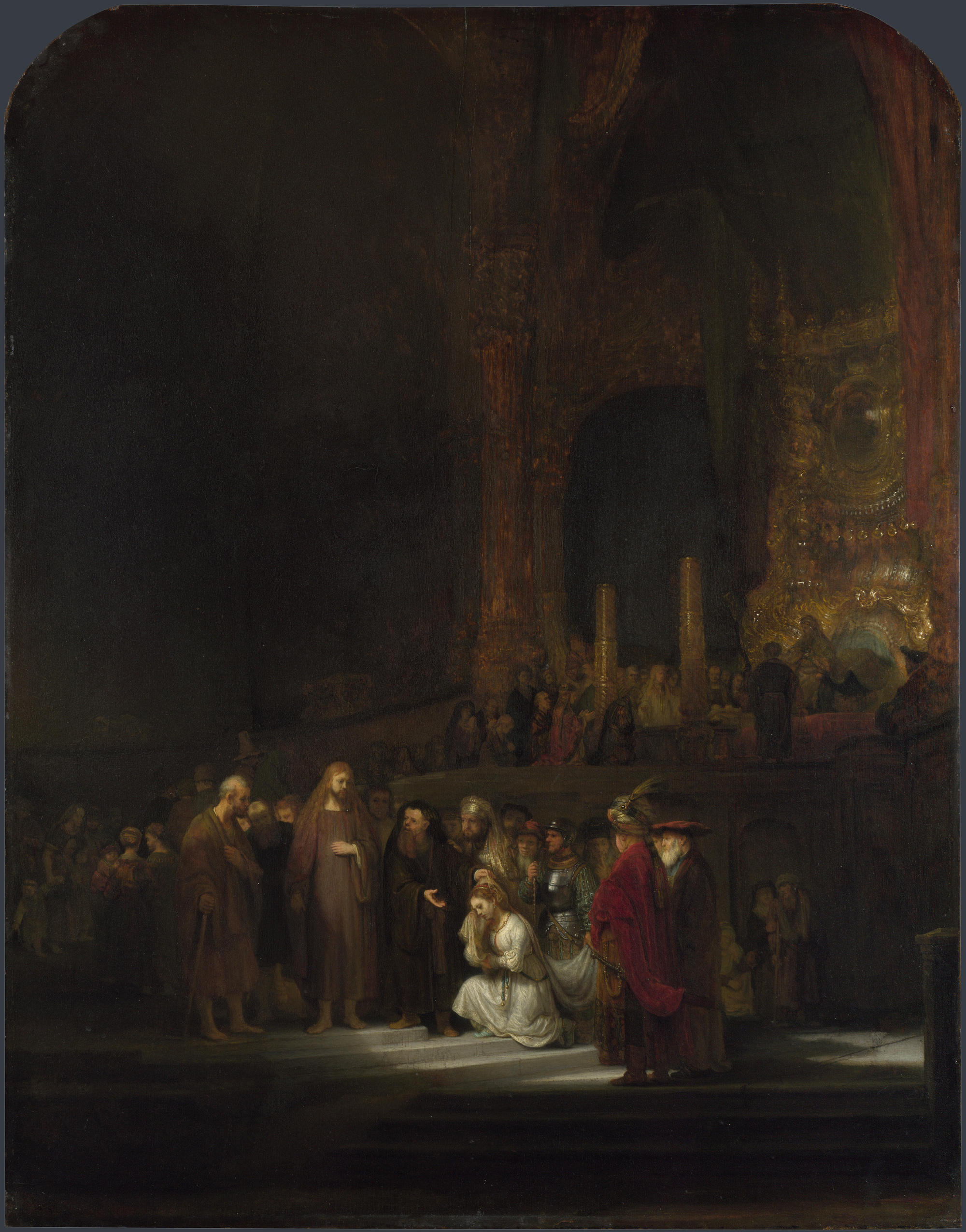
The Woman at the Well
Before You Cast That Stone
On Judgment, Partial Stories, and the Words We Can Never Take Back
Coach Weber • coachweber.org • Philippians 4:13
The crowd dragged her into the open.
She didn’t stumble — they made sure of that. They wanted her standing, visible, indictable. The scribes and Pharisees had their charge prepared, their citation from Moses ready, their stones already warm in their hands from the morning sun.
They had one piece of her story. And they were certain it was enough.
Jesus was teaching in the temple courts that morning when they interrupted Him. They pushed her forward, positioned her like evidence before a tribunal, and presented their case with complete confidence. The law was clear. The judgment, they believed, was obvious. There was nothing left to know about this woman. Nothing left worth knowing.
Jesus knelt and wrote in the dirt.
No one knows what He wrote. Scholars have speculated across two thousand years of commentary. But what He said next has echoed into every century since — into every workplace, every family, every congregation, every hallway, every comment section, every late-night conversation where someone’s reputation is being quietly dismantled without their knowledge:
“Let he who is without sin cast the first stone.” — John 8:7
One by one, beginning with the oldest, they dropped their stones and walked away.
The woman was still standing.
And Jesus, the only one in that courtyard who actually had no sin, was the only one who threw nothing.
We Are Still in That Temple
Read that story again — slowly — and notice something that should trouble each of us: the accusers were not wrong about the facts. She had been caught. The law was real. Their evidence was legitimate.
But they only had one chapter of her story.
They didn’t know her name. They didn’t know her hunger, her loneliness, her history, her wounds, her prayers in the dark, or the invisible weight she had carried to that moment in the courtyard. They didn’t know what had broken her, what she had survived, or what God intended her yet to become.
They had one chapter. And they were ready to end the book.
This pattern is as old as human nature. King David once condemned an innocent man named Mephibosheth — stripped him of everything he owned — based on a single report, from a single witness, without ever hearing the other side of the story. The truth eventually emerged, but the damage had already been done. Thousands of years later, the pattern is unchanged.
We see one action, one decision, one failure — and we write a complete verdict. We take a single frame from a lifetime of film and declare it the whole picture. We read one chapter of a person’s life and believe we understand the entire story.
We do not.
There is something deeper at stake here than fairness. Every person carries within them something that cannot be reduced to their worst moment, their most visible failure, or the chapter someone else happened to witness. Every human soul is made in the image and likeness of God. To reduce a person to a verdict, to strip away their complexity and their dignity with careless words, is to damage something that belongs to God — and to ignore everything He is still doing in that person’s life.
The tragedy of unjust criticism is not merely that the judgment is incomplete. It is that the damage is permanent.
The Cost No One Calculates
Before a stone is thrown, there is a moment of confidence. The critic knows what they know. They say what they say — and then they move on, carrying little of the weight.
The person they struck does not move on as easily.
Research confirms what the moral tradition has always understood: negative judgment elicits a stronger, more lasting response in a person than almost any other social experience. The wound from unjust criticism does not heal on the same timeline as a physical injury. It moves inward and takes up residence there — sometimes for years, sometimes permanently.
The tradition has long recognized distinct forms of harm inflicted by the careless tongue. There is the harm of assuming moral fault without sufficient evidence, of deciding someone is guilty before the case is made. There is the harm of revealing another’s genuine failures to people who have no need to know them — exposure without purpose. And there is the gravest harm of all: spreading what is not even true, building a false case against someone who never had the chance to answer it. Each of these wounds differently. All of them wound deeply.
Consider what unjust criticism actually takes from a person:
It takes their reputation — which, once damaged in a community, may take years to recover and may never fully return to what it was.
It takes their confidence — the interior voice that said “I can do this” now contends with a competing voice, louder and more persistent, that says “And look what they thought of you.”
It takes their willingness to give — the person who was open, generous, and vulnerable learns to hold back. Not because they became less, but because they learned what it sometimes costs to offer yourself.
It takes their trust in community — the place where they expected to be known and valued revealed itself as a place where they could be dismissed and diminished.
And here is what the tradition teaches that secular analysis often misses: when one member of the body suffers unjustly, all suffer. Saint Paul wrote to the church in Corinth: “If one member suffers, all suffer together with it” (1 Corinthians 12:26). Unjust criticism not only damages the person targeted. It fractures the community. It teaches everyone watching that this is a place where people are reduced rather than raised. It diminishes all of us.
None of this appears on any ledger. No one calculates it. The one who threw the stone has long forgotten the moment. The one who received it has not.
Words, once released, do not return to you.
You cannot unsay them. You cannot uncirculate the rumor. You cannot unread the email, unhear the comment in the meeting, or undo the reputation you dismantled in a hallway conversation. The person who was slandered may forgive — and they should, for their own freedom. They may even smile at you again. But they carry what you said. Long after you have forgotten the moment, they remember the words.
This is not a small thing. Choose accordingly, and choose before you speak.
He Gave Everything. It Still Wasn’t Enough.
Before you conclude that the person being criticized simply didn’t do enough — didn’t try hard enough, didn’t care enough, didn’t deserve the benefit of the doubt — consider the life of Jesus Christ.
No one in history gave more. He healed the sick at all hours without asking what they had done to deserve illness. He fed thousands from almost nothing. He forgave people whose sins were public and whose shame was complete. He wept at the graves of those He loved. He welcomed children when His own disciples tried to turn them away. He reached out and touched lepers when the entire religious establishment crossed to the other side of the road. He defended the marginalized, confronted the powerful, and spoke truth even when the cost of speaking it was everything He had.
And they crucified Him for it.
Not because He failed. Because He unsettled those who had built their identity entirely around their own authority. He was accused of healing on the wrong day. He was charged with doing miracles by the power of evil. He was condemned by people who had witnessed His mercy firsthand and still chose to see only what confirmed the conclusion they had already reached.
The Apostle Paul, who poured himself out completely in service of the gospel — who endured shipwrecks, beatings, imprisonment, and exhaustion in service of people he loved — was condemned repeatedly. Not only by those who opposed the faith, but by members of the Christian community itself. He gave his life’s work to people who questioned his motives, his authority, his authenticity, his calling. He was offered one chapter at a time to critics who had no interest in the rest of the book.
If the Son of God could give His entire life in love and service and still draw the fiercest and most unjust criticism in human history — what does that tell us about the nature of this problem?
It tells us this: unjust criticism, at its worst, has nothing to do with the truth of what the person has done. It has everything to do with what the critic cannot see, cannot accept, or cannot afford to acknowledge.
A Saint Who Served Through Darkness
Agnes Gonxha Bojaxhiu left her family at 18 to spend her life on the streets of Calcutta. She became known worldwide as Mother Teresa of Calcutta.
She picked up people the world had thrown away — the dying, the untouchable, the forgotten, those whose names were known only to God — and held them in her arms so they would not die alone. She did this not as part of a program or campaign, but because she saw the face of Christ in every suffering person she encountered. She understood, in her bones, that every soul had infinite dignity because every soul was made and loved by God.
She gave everything she had.
She was criticized anyway.
People questioned her methods, doubted her theology, challenged her motives, and wrote entire books attempting to reduce her decades of sacrifice to a series of debatable administrative decisions. Some who had never held a dying stranger in their arms felt fully authorized to evaluate the integrity of the woman who had done it for fifty years.
What almost no one outside her closest circle knew during her lifetime was this: for approximately forty years, Saint Teresa of Calcutta lived in what she called interior darkness. She felt separated from God — not occasionally, not during a difficult season, but persistently, year after year, decade after decade — even as she served in His name with every ounce of her strength. She carried a hidden interior desolation that she offered back to God as a form of participation in Christ's suffering. And she showed up anyway. She served anyway. She loved anyway, day after day, for decades.
Her critics had one chapter. They never saw the interior of the woman living in it.
That is what faithfulness can look like from the outside: ordinary, unremarkable, imperfect — until you stand close enough, and long enough, to see the cost.
The most generous people are often the least understood. Those who give the most frequently receive the least grace from those who criticize them. This is not an accident. It is one of the oldest and most grievous patterns in human nature — and it is an invitation for each of us to examine ourselves before we speak.
The Stone in Your Hand
Jesus did not shame the accusers in that temple courtyard. He did not list their sins, argue the law point by point, or demand that they defend themselves.
He simply shifted the question.
He invited every person present to hold their judgment up to the light of their own interior life — and what they saw there was sufficient.
He later told His disciples: “Do not judge, so that you may not be judged. For with the judgment you make you will be judged, and the measure you give will be the measure you get” (Matthew 7:1–2, ). He also said, “Blessed are the merciful, for they will receive mercy” (Matthew 5:7). These are not separate teachings. They are the same teaching from two directions. Mercy given flows toward mercy received. Judgment rendered without mercy invites judgment without mercy in return.
Each of us will one day stand before the One who saw everything — not just our visible actions but the interior of every moment, the motive behind every word, the suffering we caused and the suffering we endured. That is the only judgment that will ultimately matter. And the standard applied there will reflect the standard we applied here.
If you are holding a stone today — if you are about to speak about someone, post about someone, pass along something you’ve heard about someone — pause before you release it.
Ask yourself: Do I have the whole story? Not a piece of it, not the most visible chapter — the whole story.
Ask yourself: Have I walked where this person has walked? Do I know what they were carrying when they made that decision? Have I seen what they have sacrificed, what they have survived, what they have offered in rooms where no one was watching, and no one was counting?
Ask yourself: If someone applied this exact standard to me — to my worst moment, my most selfish hour, the year I failed the people who depended on me — would I want that to be the permanent and complete definition of who I am before God and everyone I love?
If the answer is no, put the stone down.
There is a profound difference between loving accountability offered in truth and charity and careless condemnation issued without knowledge. Honest, gentle correction from someone who knows you, has earned the right to speak into your life, and offers it in love, is one of the most valuable gifts one person can give another. That is not what unjust criticism is. Unjust criticism is a verdict delivered without a trial, based on incomplete evidence, by someone who never asked for the rest of the story.
One builds people. The other breaks them. Only one reflects the One who made us.
And if you have already thrown the stone — if words left your mouth that damaged someone who did not deserve it — the answer is not silence or distance or hoping they forget. The answer is to return. Go back. Apologize — not a qualified, self-protective apology that explains why you said it, but a true one. One that names the specific harm, asks nothing in return, and, where possible, actively works to repair what was damaged. The tradition teaches that when we harm another person’s reputation, we bear a responsibility not only to express sorrow but to restore what we took. That may mean correcting the record. It may mean speaking the truth about them in the same rooms where the harm was done. That is not easy. It is right. And it is what genuine conversion of heart looks like in practice.
To the One Who Is Still Standing
If you are the one who has been judged by someone holding only one chapter of your story — if you have given and given and given and been told it was not enough, not right, not what they wanted — hear this:
God sees the whole story.
Not one chapter. Not the moment you stumbled. Not the year that broke you. Not the accusation that was never actually true. He sees every sacrifice made in silence, every prayer offered in the dark, every act of faithfulness no one acknowledged, every time you kept going when stopping would have been so much easier.
He is not confused about who you are. He is not deceived by what others have said about you.
You were made in His image. You were redeemed at a price. Your worth is not determined by what critics see or say — it is grounded in something that existed before anyone formed an opinion of you and will remain long after every verdict of this world has faded.
The judgment of heaven is not issued by the people in the hallway. It is not shaped by the email chain you were never included in. It is not handed down by someone who has read one chapter of your life and decided they had seen enough. The measure that matters is not their measure. It never was.
Your calling is not to satisfy your critics. Your calling is to be faithful — to your purpose, God, and the people He has placed in your path. Continue in that faithfulness. Stay true to what you know is right. Do good even when doing good costs you something. Forgive those who have not yet earned it, not only for their sake, but because carrying unforgiveness is a burden too heavy and too costly for the road you have been given to walk.
Pray for them. This is not a platitude. It is the hardest and most transforming discipline in the human experience. It will change you more than it changes them. And that is precisely the point.
When the weight of undeserved judgment presses its hardest against you — when it makes you question whether faithfulness is worth the cost — remember this: the greatest life ever lived on this earth was also the most unjustly criticized.
You are not alone. You are in extraordinary company.
And one day, in the only courtroom that matters, the full story will be told.
“I can do all things through Christ who strengthens me.”
— Philippians 4:13
Coach Weber
coachweber.org

A Note on Sources and Images
Scripture quotations are from the New Revised Standard Version, Catholic Edition (NRSV-CE). The account of the woman caught in adultery: John 8:1–11. King David and Mephibosheth: 2 Samuel 16:1–4 and 19:24–30. The Body of Christ: 1 Corinthians 12:26. The Beatitudes: Matthew 5:7. Do not judge: Matthew 7:1–2. Saint Teresa of Calcutta’s interior darkness was published posthumously in Come Be My Light (2007), edited by Brian Kolodiejchuk, M.C. The image of Christ and the Woman Taken in Adultery (1644) is by Rembrandt van Rijn and is in the public domain; download free at commons.wikimedia.org/wiki/File:Rembrandt_Christ_and_the_Woman_Taken_in_Adultery.jpg. Search Wikimedia Commons for ‘Mother Teresa’ for public domain image options.
About the author
Coach Larry Weber is a 2026 Washington State Cross Country Coaches Hall of Fame inductee and the author of Jesus on the Track: A Christian Athlete's Guide to Handling Hard Days, Building Mental Toughness, and Growing in Faith — a short formation book for Christian athletes, coaches, and parents.
Available now on Kindle for $4.99. Read it on Amazon at the link below.
100% of the net proceeds go directly to building youth running program.
Philippians 4:13